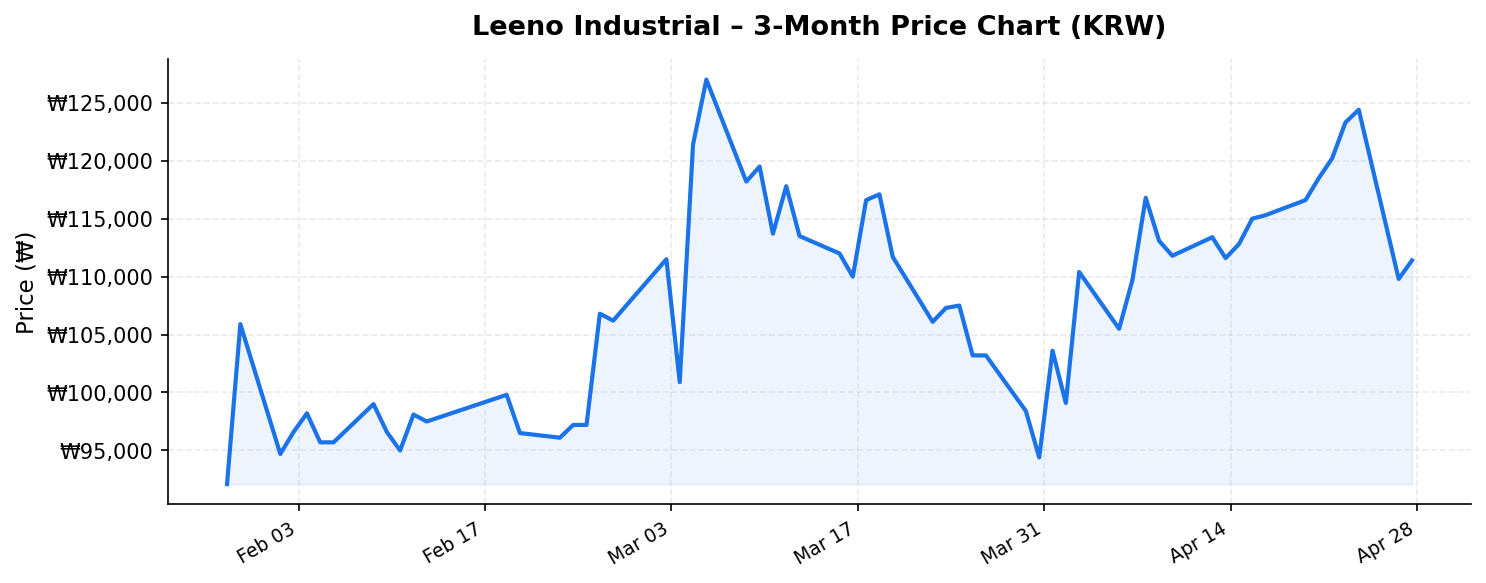
In a market environment where semiconductor-related stocks have captured global investor attention, few names on the Korean exchange have delivered a performance as staggering as Leeno Industrial (리노공업, 058470.KS). As of April 29, 2026, the stock trades at ₩219,500 — a price that sits a remarkable 92.0% above its 52-week high of ₩114,300 and more than 540% above its 52-week low of ₩34,280. These are not ordinary numbers. They demand serious scrutiny from international investors trying to determine whether this rally is grounded in fundamentals or driven by speculative excess.
This analysis breaks down Leeno Industrial’s business model, competitive moat, recent performance drivers, key risks, and what the current valuation might mean for investors considering an entry — or an exit — at these levels.
Business Overview: The Hidden Pick-and-Shovel Play in Semiconductors
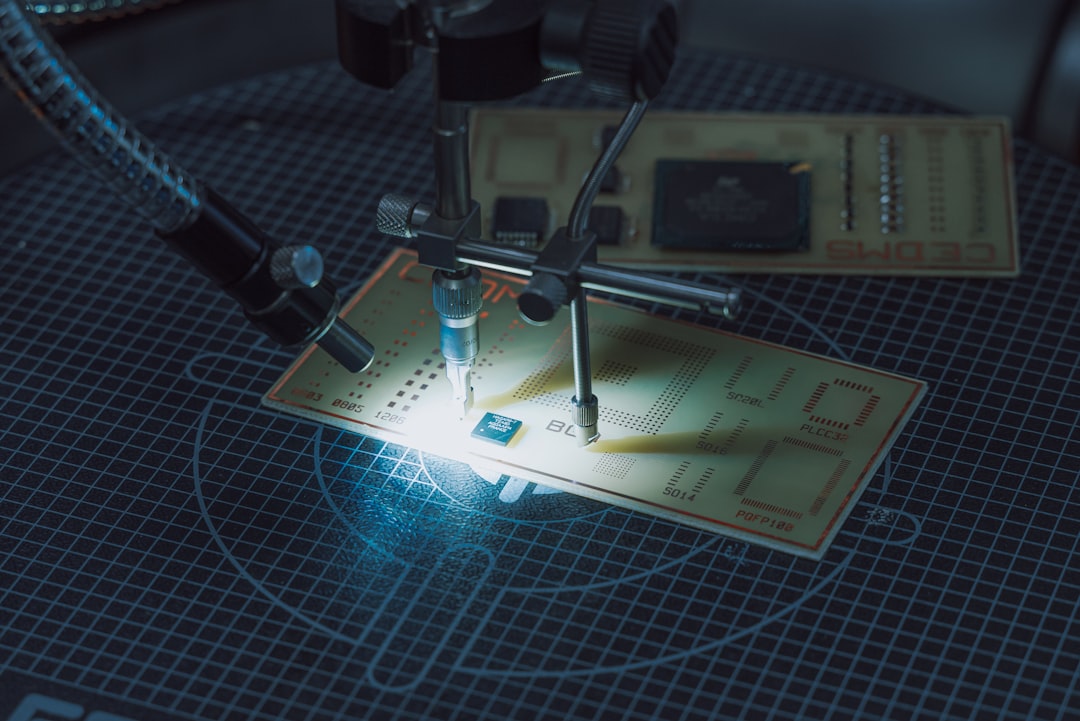
Leeno Industrial is a South Korean manufacturer specializing in test sockets, probe pins, and contact probes — critical consumable components used in the semiconductor testing process. Every chip that rolls off a fabrication line must be tested before it ships to customers, and Leeno’s products serve as the physical interface between the chip and the test equipment. Think of them as the “pick and shovel” supplier in a semiconductor gold rush.
Founded in 1978 and headquartered in Daegu, South Korea, the company has built a dominant position in the global test socket and probe pin market over nearly five decades. Its customer base reads like a who’s-who of the semiconductor industry, spanning major foundries, integrated device manufacturers (IDMs), outsourced semiconductor assembly and test (OSAT) providers, and fabless chip designers worldwide.
What makes Leeno particularly compelling from a business quality standpoint is its consumable-driven revenue model. Test sockets and probe pins wear out with use and must be regularly replaced, creating a recurring revenue stream that is less cyclical than semiconductor capital equipment. As global chip production volumes grow — driven by AI, automotive electrification, IoT, and advanced packaging — Leeno’s addressable market expands in tandem.
The company has historically maintained operating margins in the 30-40% range and return on equity figures that consistently rank among the highest in the Korean industrial sector. Its asset-light model, combined with deep engineering expertise in precision metalworking and miniaturization, has allowed it to generate substantial free cash flow relative to its size.
What’s Driving the Parabolic Move? AI Demand and Advanced Packaging Tailwinds
The most pressing question for any investor looking at a stock trading at ₩219,500 — well above the prior 52-week high of ₩114,300 — is simple: what changed?
Several converging trends explain Leeno Industrial’s extraordinary run:
- AI chip testing intensity: Advanced AI accelerators from companies like NVIDIA, AMD, and emerging custom silicon designers require significantly more testing per wafer than traditional logic chips. The complexity of these devices — with their massive die sizes, advanced nodes (3nm and below), and high-bandwidth memory (HBM) integration — has driven a step-function increase in demand for high-precision test interfaces. Leeno’s probe pins and test sockets are directly benefiting from this shift.
- Advanced packaging proliferation: The industry’s move toward 2.5D and 3D chiplet architectures, CoWoS (Chip-on-Wafer-on-Substrate), and hybrid bonding has created entirely new test points in the manufacturing flow. Each layer and interposer requires testing, multiplying the number of contact events per finished package and thus the demand for Leeno’s consumables.
- Capacity expansion at major foundries: TSMC, Samsung Foundry, and Intel Foundry Services have all announced aggressive capacity expansion plans through 2027. More fabrication capacity means more wafers produced, more chips tested, and more probe pins consumed. Leeno is a direct beneficiary of every incremental wafer start globally.
- Market share gains: Reports from Korean brokerage houses suggest Leeno has been gaining share in the high-end test socket segment, particularly for HBM testing applications. Its engineering capabilities in ultra-fine-pitch probe technology have given it a technical edge over competitors as interconnect densities increase.
These are not transient factors. The AI infrastructure buildout is widely expected to sustain elevated semiconductor testing demand for multiple years, and Leeno sits at a critical nexus of that supply chain.
Valuation Reality Check: Can the Fundamentals Support ₩219,500?
Here is where international investors need to exercise discipline. A stock that has surged more than 540% from its 52-week low of ₩34,280 to its current level of ₩219,500 is, by definition, pricing in an enormous amount of future growth. The 52-week high of ₩114,300 — itself a level that likely seemed ambitious just a year ago — is now nearly half the current share price.
Based on consensus estimates compiled by Korean brokerages in early 2026, Leeno Industrial’s forward price-to-earnings ratio at current prices is likely in the 40-55x range, depending on which fiscal year estimates investors use. This represents a significant premium to the company’s historical average P/E of approximately 20-30x and places it in the upper echelon of global semiconductor equipment and consumables valuations.
For context, consider the following comparison points:
- Leeno’s historical P/E range: Approximately 15-35x over the past decade, with peaks during previous semiconductor upcycles.
- Global test equipment peers: Companies like Cohu (COHU), FormFactor (FORM), and Technoprobe trade at forward P/E multiples generally in the 20-35x range during strong demand periods.
- Current implied growth expectations: At ₩219,500, the market appears to be pricing in earnings growth of 40-60% or more over the next two years — achievable if the AI testing thesis plays out, but leaving little room for disappointment.
On the positive side, Leeno’s balance sheet remains fortress-like, with minimal debt and substantial cash reserves. The company has historically paid dividends, though at the current elevated share price, the dividend yield is likely compressed below 0.5%, making it a non-factor for income-oriented investors. The investment case here is purely about capital appreciation driven by earnings growth.
International investors should also consider the won-denominated nature of this investment. Currency fluctuations between the Korean won and the investor’s home currency can materially affect returns, particularly over shorter holding periods.
Key Risks: What Could Derail the Thesis?
No analysis is complete without a sober assessment of risks, and at a valuation this elevated, the downside scenarios deserve serious attention:
- Semiconductor cycle normalization: The semiconductor industry remains fundamentally cyclical. If AI-related capital spending slows or pauses — as it inevitably will at some point — testing demand could plateau, and Leeno’s growth rate could decelerate sharply. At 40-55x earnings, any growth disappointment could trigger a severe multiple compression.
- Competitive threats: While Leeno holds a strong position, Japanese competitors like Yokowo and Nidec SV Probe, as well as emerging Chinese suppliers, are investing heavily in test probe and socket technology. Sustained market share erosion, even if gradual, would undermine the growth narrative.
- Customer concentration risk: Leeno derives a meaningful portion of revenue from a relatively concentrated set of major customers. Loss of a key account or a shift in a major customer’s testing strategy could have outsized impact.
- Valuation fragility: A stock trading 92% above its prior 52-week high carries significant mean-reversion risk. Even if the fundamental story remains intact, profit-taking, shifts in market sentiment, or broader market corrections in Korean equities could lead to sharp drawdowns. The distance between ₩219,500 and the 52-week low of ₩34,280 underscores how violent price swings can be in this name.
- Liquidity considerations: As a mid-cap Korean stock, Leeno Industrial may have lower daily trading volumes compared to mega-cap names like Samsung Electronics. International investors, particularly institutional ones, may face liquidity constraints when building or exiting positions.
Investment Thesis: Exceptional Business, Extraordinary Price
Leeno Industrial is, by virtually any measure, a high-quality business. It operates in a structurally growing niche, holds meaningful competitive advantages in precision manufacturing, generates excellent margins and returns on capital, and is positioned at the heart of the most powerful secular trend in technology — the AI infrastructure buildout.
The challenge for international investors in April 2026 is not the quality of the business but the price of admission. At ₩219,500, with the stock sitting 92% above its 52-week high of ₩114,300, the market has already priced in a best-case scenario for the next several years. Investors entering at these levels are essentially betting that reality will match or exceed already-lofty expectations — and that the premium multiple will be sustained.
For long-term investors with high conviction in the multi-year AI testing demand thesis and a tolerance for volatility, Leeno Industrial offers exposure to an irreplaceable node in the semiconductor supply chain. However, position sizing discipline is paramount. Allocating a modest portfolio weight and being prepared for drawdowns of 30-50% — which would still leave the stock well above its 52-week low — is a prudent approach.
For more value-conscious investors, the better strategy may be to place Leeno Industrial on a watchlist and wait for a meaningful pullback. The business will likely remain excellent through cycles; the stock price is what introduces risk at these levels.
Ultimately, Leeno Industrial represents one of Korea’s most compelling semiconductor-adjacent stories, but international investors must weigh the strength of the business against the exuberance embedded in the current share price. Great companies can still be poor investments if bought at the wrong price.

Disclaimer: This article is for informational and educational purposes only and does not constitute financial advice, investment recommendations, or a solicitation to buy or sell any securities. All data referenced is based on publicly available information as of April 29, 2026. Investors should conduct their own due diligence and consult with a qualified financial advisor before making any investment decisions. Past performance is not indicative of future results.