
Introduction: A Korean Tech Icon Trading at a Steep Discount
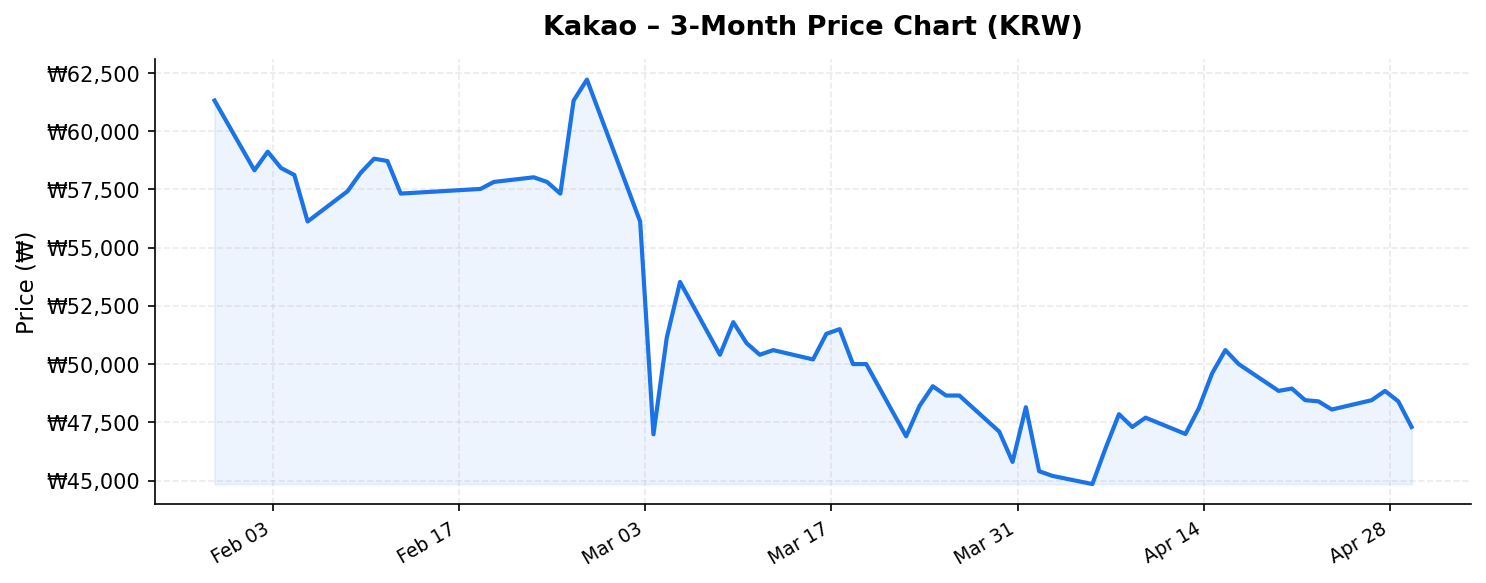
Kakao (카카오, 035720.KS), South Korea’s dominant internet platform company, finds itself in an unusual position in early May 2026. The stock is currently trading at ₩47,300, a staggering 33.9% below its 52-week high of ₩71,600 and only modestly above its 52-week low of ₩36,300. For international investors scanning Asia’s technology landscape for opportunity, this raises a critical question: does Kakao represent a compelling deep-value entry point into one of Korea’s most important digital ecosystems, or is the market signaling fundamental problems that justify the discount?
With a market capitalization of ₩20.8 trillion (approximately $15 billion USD), trailing twelve-month revenue of ₩8.1 trillion, and a headline-grabbing dividend yield of 16.00%, the numbers at first glance look extraordinary. But as any seasoned investor knows, extraordinary numbers demand extraordinary scrutiny. Let’s break down the investment case.

Business Overview: The Backbone of Korea’s Digital Life
To understand Kakao, you must first understand KakaoTalk — the messaging application used by over 95% of South Korea’s smartphone users. In a market of 52 million people, KakaoTalk is not merely an app; it is the de facto communication infrastructure of the nation. This dominant messaging platform serves as the gateway to Kakao’s sprawling ecosystem of services spanning fintech, mobility, entertainment, commerce, AI, and cloud computing.
Kakao’s business segments include:
- Platform segment: Advertising revenue from KakaoTalk, Daum portal, and Kakao’s various digital services. This segment benefits from the company’s unmatched user engagement across South Korea.
- Content segment: Kakao Entertainment (music streaming via Melon, webtoons via Kakao Webtoon, and Kakao Page) and gaming through Kakao Games. The global webtoon boom has been a significant growth driver.
- Fintech and mobility: KakaoPay (digital payments and financial services), KakaoBank (one of Korea’s leading digital banks, publicly listed separately), and Kakao Mobility (ride-hailing, navigation).
- Other ventures: Kakao’s AI initiatives, cloud services, and enterprise solutions represent emerging growth vectors.
With TTM revenue of ₩8.1 trillion, Kakao is firmly one of Korea’s largest internet companies. However, the company’s return on equity of just 3.6% signals that profitability conversion remains a significant challenge. Kakao has historically prioritized ecosystem expansion and market share over margin optimization — a strategy that has built an impressive conglomerate but one that has not always rewarded shareholders in the near term.
Valuation and Dividend: Parsing the Numbers
The most eye-catching data point for income-oriented investors is Kakao’s current dividend yield of 16.00%. At first glance, this figure seems almost too good to be true for a technology company — and it warrants careful examination. A 16% yield on a tech platform company in Korea is highly anomalous and could stem from several factors: a special one-time dividend, a restructuring-related capital return program, or the distribution of proceeds from subsidiary disposals or listings.
International investors should investigate whether this yield is sustainable on an ongoing basis. If Kakao has embarked on a shareholder return program — possibly returning cash from the monetization of its extensive subsidiary portfolio — the yield could be a deliberate strategic pivot toward returning value to shareholders. Alternatively, if it represents a one-off event, the forward yield could be dramatically lower. Either way, at the current price of ₩47,300, the market is clearly not pricing in a sustainable 16% yield, which suggests skepticism about its repeatability.
From a valuation perspective, the price-to-sales ratio stands at approximately 2.6x (₩20.8T market cap / ₩8.1T revenue), which is modest for a platform-driven technology company with Kakao’s market position. For comparison, global internet peers often trade at 4-8x revenue. The low ROE of 3.6% partially explains this discount — investors are paying less per unit of revenue because less of that revenue drops to the bottom line.
The stock’s position within its 52-week range is also telling. At ₩47,300, Kakao sits roughly 31% above its 52-week low of ₩36,300 but 34% below its high of ₩71,600. This mid-range positioning suggests the market has partially recovered from whatever crisis or sentiment shock drove the stock to its lows but remains far from recapturing its prior optimism. For investors with a contrarian bent, this asymmetry — more upside to the high than downside to the low — is worth noting.
Competitive Position and Growth Catalysts
Kakao’s competitive moat is anchored in network effects. KakaoTalk’s near-universal adoption in South Korea creates switching costs that are virtually insurmountable for competitors. Unlike in markets such as the United States or Europe, where messaging is fragmented across iMessage, WhatsApp, and other platforms, Korea’s messaging market is essentially a monopoly. This gives Kakao an unparalleled distribution channel for any new service it launches.
Several potential catalysts could drive a re-rating of the stock:
- AI integration: Kakao has been investing heavily in AI capabilities, including large language models and AI-powered services across its platform. Successful monetization of AI features within KakaoTalk’s massive user base could unlock significant incremental revenue.
- Global content expansion: Kakao Entertainment’s webtoon and web novel businesses have significant international growth potential. The global appetite for Korean content — buoyed by the broader Hallyu (Korean Wave) trend — provides a tailwind.
- Margin improvement: With a 3.6% ROE, there is substantial room for operational efficiency gains. Any credible restructuring or cost optimization initiative could meaningfully improve profitability and drive a valuation re-rating.
- Subsidiary value realization: Kakao’s portfolio of subsidiaries — including significant stakes in publicly listed KakaoBank and KakaoPay — represents value that may not be fully reflected in the parent company’s share price. Sum-of-the-parts analyses often suggest the parent trades at a holding company discount.
On the competitive front, Kakao faces pressure from Naver (Korea’s other tech giant), global players like Google and Apple expanding services in Korea, and regulatory headwinds. However, its messaging dominance provides a defensive moat that few competitors can realistically challenge.
Key Risks for International Investors
Investing in Kakao from abroad comes with several layers of risk that deserve careful consideration:
- Regulatory risk: Kakao has faced intense regulatory scrutiny in Korea following its 2022 data center outage and ongoing antitrust investigations. The Korean government has shown willingness to impose structural changes on large platform companies. For international investors, regulatory developments can be difficult to track and predict.
- Corporate governance concerns: The arrest of Kakao’s founder, Kim Beom-su, in 2024 on stock manipulation charges related to the SM Entertainment acquisition sent shockwaves through the investor community. Although governance reforms may be underway, the incident highlighted risks inherent in Korea’s chaebol-adjacent corporate structures.
- Profitability challenges: The 3.6% ROE is well below what international tech investors typically expect. If Kakao cannot demonstrate a clear path to improved margins, the stock may remain in value-trap territory regardless of its revenue scale.
- Currency risk: International investors are exposed to KRW/USD fluctuations. A weakening Korean won can erode returns even if the stock price appreciates in local currency terms.
- Conglomerate discount: Kakao’s sprawling structure, with numerous subsidiaries and affiliates, creates complexity that the market typically penalizes. Simplification of the corporate structure could unlock value, but such moves are not guaranteed.
Investment Thesis: Opportunity Amid Uncertainty
For international investors with a medium to long-term horizon, Kakao presents a nuanced opportunity. The bull case rests on three pillars: (1) an irreplaceable platform position in Asia’s fourth-largest economy, (2) a valuation (2.6x P/S) that is cheap relative to global internet peers, and (3) potential catalysts including AI monetization, global content growth, and improved capital allocation as evidenced by the elevated dividend yield.
The bear case centers on persistently low profitability (3.6% ROE), regulatory overhang, governance concerns, and the possibility that the extraordinary 16% dividend yield is not sustainable, which would remove a key pillar of the investment thesis once normalized.
At ₩47,300 — roughly a third below its 52-week high — much of the bad news appears to be priced in. However, international investors should size positions conservatively, conduct due diligence on the sustainability of the dividend, and monitor regulatory developments closely. For those who believe in the long-term value of platform monopolies and Korea’s digital economy, Kakao at these levels merits serious consideration as a portfolio position with meaningful upside potential and identifiable, manageable risks.
The stock is best suited for patient investors who can tolerate volatility and complexity in exchange for exposure to one of Asia’s most deeply embedded digital ecosystems at a historically discounted price.

Disclaimer: This blog post is for informational and educational purposes only and does not constitute financial advice, investment advice, or a recommendation to buy or sell any securities. Investors should conduct their own research and consult with a qualified financial advisor before making any investment decisions. Market data referenced is as of May 1, 2026, and may have changed since publication. Investing in foreign equities involves additional risks including currency fluctuation and differing regulatory environments.