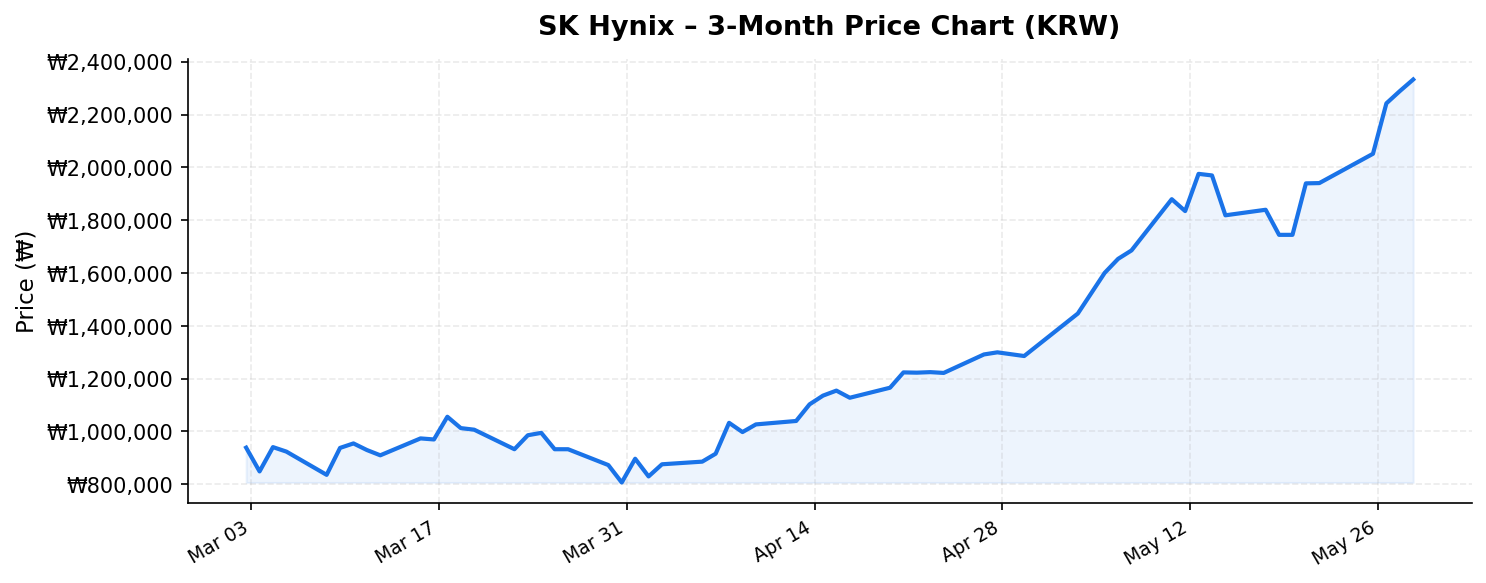
In the global semiconductor landscape, few stories have been as compelling as the meteoric rise of SK Hynix (SK하이닉스, 000660.KS). As of May 30, 2026, the South Korean memory chip powerhouse is trading at ₩2,333,000 per share — just 1.9% below its 52-week high of ₩2,379,000 — with a staggering market capitalization of ₩1,656.1 trillion (approximately $1.2 trillion USD). For international investors searching for exposure to the AI-driven semiconductor supercycle, SK Hynix demands serious attention. But at these elevated levels, the critical question remains: is there still value to be found, or has the market already priced in the best of the boom?
Business Overview: The Backbone of the AI Memory Revolution
SK Hynix is the world’s second-largest memory semiconductor manufacturer, trailing only Samsung Electronics in DRAM market share while holding a dominant position in the high-bandwidth memory (HBM) segment that has become the lifeblood of artificial intelligence infrastructure. The company designs and manufactures DRAM, NAND flash memory, and advanced packaging solutions from its fabrication facilities primarily located in Icheon and Cheongju, South Korea, with expanding operations in the United States and China.
What has truly differentiated SK Hynix in recent years is its first-mover advantage in HBM chips — the specialized, vertically stacked memory modules required by NVIDIA’s GPU accelerators and other AI training hardware. SK Hynix was the first to mass-produce HBM3 and HBM3E, securing a commanding share of supply contracts with NVIDIA, and has maintained its technological lead as the industry transitions to next-generation HBM4 products. This strategic positioning has been the primary catalyst behind the company’s extraordinary financial performance.
The numbers speak for themselves. SK Hynix posted trailing twelve-month (TTM) revenue of ₩132.1 trillion, a figure that would have seemed almost unimaginable just three years ago when the company was navigating the depths of a brutal memory downcycle. The return on equity stands at a remarkable 61.2%, reflecting not just top-line growth but exceptional profitability driven by the premium pricing power of HBM products and disciplined capacity management across its conventional memory lines.
Valuation and Market Position: Parsing the Premium
At ₩2,333,000 per share, SK Hynix has appreciated more than tenfold from its 52-week low of ₩203,000, a range that underscores just how violently cyclical the memory industry can be — and how dramatically the AI narrative has reshaped the company’s earnings trajectory. Trading within 2% of its all-time high, the stock is clearly in momentum territory, and some investors may feel they’ve missed the move.
However, traditional valuation metrics tell a more nuanced story. With TTM revenue of ₩132.1 trillion against a market cap of ₩1,656.1 trillion, SK Hynix trades at a price-to-sales ratio of approximately 12.5x. While that’s elevated relative to historical norms for memory companies, it’s arguably justified given the structural shift in the company’s product mix toward high-margin HBM, which commands ASPs (average selling prices) several multiples above conventional DRAM. The 61.2% ROE further validates that this is not merely a revenue story but a profitability transformation.
Perhaps the most eye-catching figure for income-oriented international investors is the 13.00% dividend yield. This is extraordinarily high for a technology company of this scale and reflects management’s confidence in the sustainability of its cash flows. SK Hynix has historically been conservative with shareholder returns, making this yield a strong signal that the company views its current earnings power as durable rather than fleeting. For investors in jurisdictions with favorable tax treaties with South Korea (such as the UK, the Netherlands, or Singapore), the after-tax yield remains highly attractive.
It’s worth noting, however, that international investors should factor in South Korea’s withholding tax on dividends (typically 22% for non-residents, though treaty rates may apply) and any currency risk between the Korean won and their home currency when evaluating the effective yield.
Competitive Landscape and Strategic Advantages
SK Hynix operates in a tightly consolidated oligopoly. The global DRAM market is essentially a three-player game — Samsung Electronics, SK Hynix, and Micron Technology — while NAND flash includes a few additional competitors such as Kioxia and Western Digital. This oligopolistic structure has historically allowed for periods of exceptional profitability when supply discipline holds, as it appears to be doing in the current cycle.
In HBM specifically, SK Hynix’s competitive moat is formidable:
- Technological leadership: SK Hynix has consistently been 6-12 months ahead of Samsung and Micron in qualifying new HBM generations with key customers. Its HBM3E products achieved mass production milestones ahead of competitors, and early reports suggest its HBM4 roadmap remains on track for late 2026 volume production.
- Customer lock-in: NVIDIA, AMD, and major hyperscale cloud providers have deep co-development relationships with SK Hynix. Switching memory suppliers for AI accelerators involves lengthy qualification processes, creating significant customer stickiness.
- Advanced packaging capabilities: The company has invested heavily in its hybrid bonding and through-silicon via (TSV) technologies, which are critical bottlenecks in HBM manufacturing. These capabilities are difficult and capital-intensive to replicate.
- Capacity discipline: Unlike previous memory cycles where overbuilding destroyed margins, SK Hynix has been notably restrained in conventional DRAM capacity additions, channeling capital expenditure toward HBM and advanced nodes instead.
Samsung Electronics remains the most formidable competitor, with its own HBM4 development efforts intensifying and its vertically integrated manufacturing model providing cost advantages. Micron, meanwhile, has been gaining ground in HBM3E qualification. International investors should monitor whether SK Hynix can sustain its premium positioning as competitors close the gap.
Key Risks: What Could Derail the Thesis?
Despite the compelling fundamentals, several risks warrant careful consideration:
- Cyclicality remains inherent: The memory industry has never permanently escaped its boom-bust nature. While AI demand provides a structural demand floor that didn’t exist in previous cycles, conventional DRAM and NAND remain commodity products subject to oversupply. The 52-week range of ₩203,000 to ₩2,379,000 — a spread of more than 10x — is a vivid reminder of how quickly sentiment and earnings can shift in this sector.
- AI spending deceleration: SK Hynix’s premium valuation is heavily predicated on continued exponential growth in AI infrastructure spending. Any slowdown in capital expenditure from hyperscalers — whether due to macroeconomic weakness, regulatory intervention, or diminishing returns on AI investments — could materially impact HBM demand and pricing.
- Geopolitical risk: The U.S.-China technology war continues to create uncertainty. SK Hynix operates a major DRAM facility in Dalian, China, and has received limited waivers from U.S. export controls. Any tightening of restrictions could disrupt operations and market access. Additionally, escalating tensions on the Korean Peninsula remain a tail risk that international investors must acknowledge.
- Customer concentration: A significant portion of HBM revenue is believed to flow from NVIDIA. While this relationship is a strength today, overdependence on a single customer creates vulnerability if NVIDIA diversifies its supply chain or shifts its memory architecture.
- Currency and tax considerations: International investors face won-denominated exposure. A strengthening home currency against the won would erode returns even if the stock price holds steady. The high dividend yield of 13% also creates a meaningful tax drag for investors in unfavorable withholding tax jurisdictions.
Investment Thesis: Where Does SK Hynix Fit in a Global Portfolio?
For international investors, SK Hynix represents one of the purest large-cap plays on the AI infrastructure buildout. The investment case rests on three pillars: structural demand growth for HBM driven by AI model scaling, an oligopolistic industry structure that supports pricing power, and a management team that has demonstrated both technological foresight and capital discipline.
The financial profile is exceptional by any standard. A 61.2% return on equity places SK Hynix among the most profitable large-cap technology companies globally. TTM revenue of ₩132.1 trillion reflects the massive scale of its operations, while the 13% dividend yield provides tangible shareholder returns that are rare in the semiconductor sector. The stock’s proximity to its 52-week high (just 1.9% below) signals strong market conviction, though it also means there is limited margin of safety at current levels.
The ideal entry point for long-term investors would come during one of the periodic sentiment-driven pullbacks that characterize the memory sector. However, waiting for a deep correction carries the risk of missing further upside if the AI demand cycle proves more durable than previous memory booms. A measured approach — building a position gradually rather than deploying capital all at once — may be the most prudent strategy for those looking to gain exposure.
SK Hynix is not a stock for the faint of heart. Its history is one of extreme volatility, and the current valuations embed significant optimism about the future. But for investors who believe the AI revolution is still in its early innings and who can tolerate the inherent cyclicality of the memory business, SK Hynix offers a rare combination of growth, profitability, and income that is difficult to find elsewhere in global equity markets.
Disclaimer: This article is for informational and educational purposes only and does not constitute financial advice, investment recommendations, or an offer to buy or sell securities. All data is sourced from publicly available market information as of May 30, 2026. Investors should conduct their own due diligence and consult with a qualified financial advisor before making any investment decisions. Past performance is not indicative of future results.