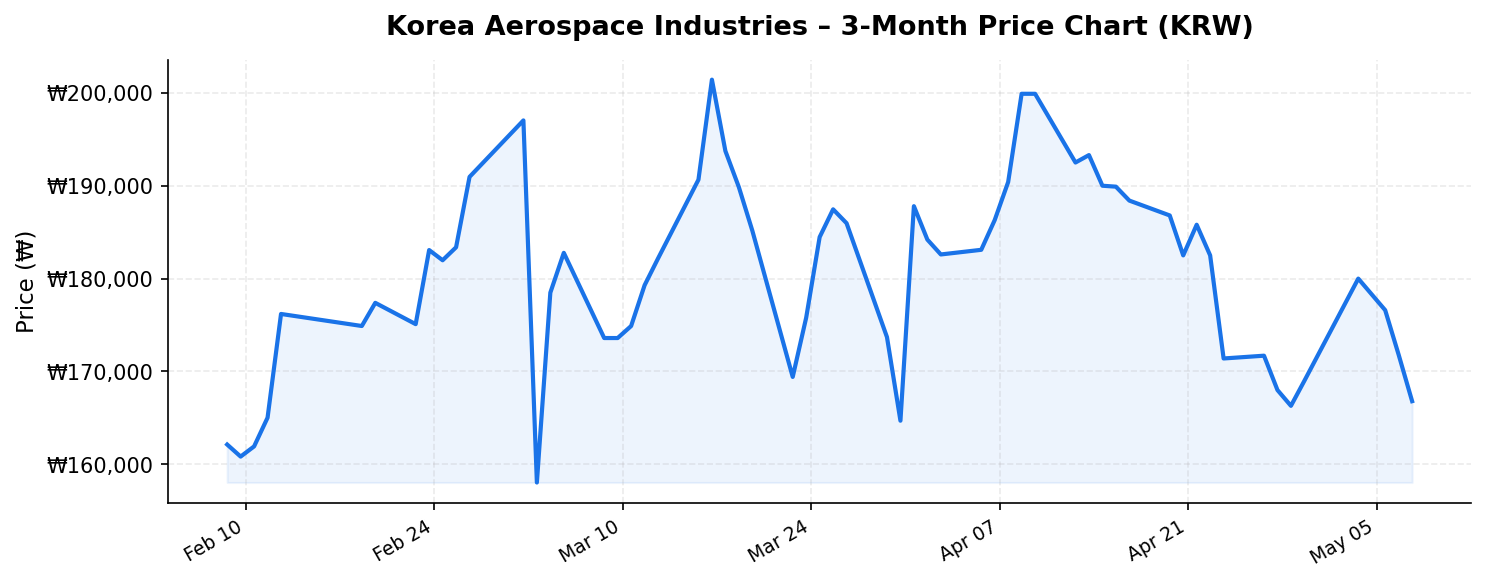
In an era defined by escalating geopolitical tensions across the Indo-Pacific, rising global defense budgets, and a generational shift in how nations procure military hardware, few companies sit at a more consequential intersection than Korea Aerospace Industries (한국항공우주, 047810.KS). As South Korea’s sole fixed-wing aircraft manufacturer and a pillar of the country’s ambitious defense export strategy, the company has transformed from a domestic military contractor into a globally competitive aerospace platform. Trading at ₩166,800 as of May 10, 2026, with a market capitalization of ₩16.3 trillion (~$11.8 billion), Korea Aerospace Industries currently sits 22.6% below its 52-week high of ₩215,500 — a discount that demands serious analysis from international investors weighing the defense sector’s long-term trajectory.

Business Overview: South Korea’s Aerospace National Champion
Korea Aerospace Industries is not just another defense contractor — it is effectively a national strategic asset. Formed in 1999 through the consolidation of the aerospace divisions of Samsung, Daewoo, and Hyundai, the company holds a monopoly position in South Korean military aircraft manufacturing. Its product portfolio spans the full spectrum of aerospace and defense:
- KF-21 Boramae: South Korea’s indigenous 4.5-generation fighter jet, one of the most ambitious defense development programs in Asia. The KF-21 is expected to enter mass production in the coming years, with South Korea planning to acquire 120 units and export interest already emerging from Poland, Iraq, and several Southeast Asian nations.
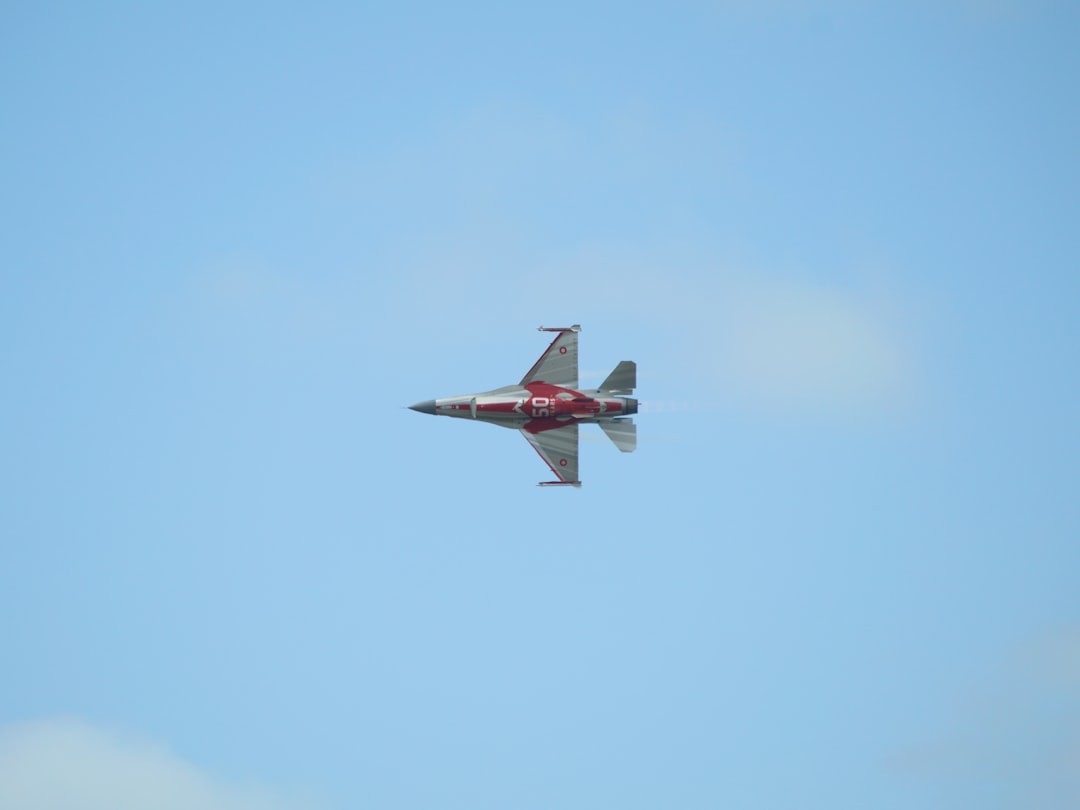
- FA-50 Light Combat Aircraft: Already a proven export success with deliveries to Poland, the Philippines, Malaysia, and others. The FA-50 occupies a sweet spot in the global market — more capable than trainer aircraft, significantly cheaper than frontline fighters.
- KUH-1 Surion Helicopter: A medium-class utility helicopter serving the South Korean military, with derivative variants being developed for export and civilian use.
- Aerostructures: Korea Aerospace Industries manufactures major components for global OEMs including Boeing and Airbus, providing a commercial aerospace revenue stream that diversifies its defense-heavy portfolio.
With trailing twelve-month revenue of ₩3.7 trillion (~$2.7 billion), the company has been on a clear growth trajectory, driven by both domestic procurement cycles and a surge in defense exports that has positioned South Korea as the world’s ninth-largest arms exporter. The company’s return on equity stands at 10.3% — respectable for a capital-intensive defense manufacturer, though below the levels seen at more mature Western peers like Lockheed Martin or Rheinmetall. This reflects the heavy R&D investment phase Korea Aerospace Industries is still navigating, particularly around the KF-21 program.
Valuation and Market Position: Opportunity in the Pullback?
The current share price of ₩166,800 places Korea Aerospace Industries in interesting territory. After surging from a 52-week low of ₩82,250 — meaning the stock has still roughly doubled from its trough — the 22.6% retreat from the ₩215,500 high creates a potential entry point for investors who missed the initial defense sector rally. The price-to-sales ratio, based on the ₩16.3 trillion market cap against ₩3.7 trillion in TTM revenue, works out to approximately 4.4x — a premium to historical Korean defense valuations but not unreasonable given the company’s export momentum and the KF-21’s production pipeline.
What truly stands out in the data, however, is the reported dividend yield of 30.00%. This extraordinary figure warrants careful scrutiny. For a defense manufacturer generating ₩3.7 trillion in revenue, sustaining a 30% dividend yield on a ₩16.3 trillion market cap would imply annual dividend payments of roughly ₩4.9 trillion — far exceeding total revenue, let alone earnings. This almost certainly reflects a special dividend event, possibly tied to a one-time capital return, asset sale proceeds, or a reclassification in payout structure. International investors should not treat this as a recurring yield. Instead, it should be investigated thoroughly — if it represents a genuine special distribution, it could signal management confidence in the balance sheet; if it’s a data anomaly, it should be disregarded entirely in valuation models. The underlying ordinary dividend policy for Korea Aerospace Industries has historically been modest, with yields typically in the 0.5%–1.5% range.
Comparatively, global defense peers trade at varying multiples: Lockheed Martin at roughly 1.7x sales but with far higher margins, BAE Systems at around 1.5x, and Hanwha Aerospace — Korea Aerospace Industries’ closest domestic peer — at elevated multiples reflecting its own growth narrative. Korea Aerospace Industries’ premium valuation is a bet on future revenue acceleration, particularly from KF-21 mass production and continued FA-50 export wins.
Growth Catalysts and Competitive Advantages
Several powerful tailwinds support the bull case for Korea Aerospace Industries:
- KF-21 Production Ramp: The transition from development to serial production represents the single most significant revenue catalyst in the company’s history. Each KF-21 unit is estimated to cost $65–80 million, and a 120-unit domestic order alone could generate $8–10 billion in lifetime revenue. Export contracts — with Poland reportedly in advanced discussions — could multiply this figure substantially.
- Defense Export Boom: South Korea’s defense exports have surged past $17 billion in annual agreements in recent years, with the government actively supporting Korea Aerospace Industries as a flagship exporter. The FA-50’s competitive pricing (roughly $30–50 million per unit versus $80+ million for an F-16V) makes it particularly attractive to mid-tier military powers upgrading from legacy platforms.
- Geopolitical Demand Environment: NATO expansion, Indo-Pacific rearmament, and the Ukraine conflict’s ripple effects have accelerated global defense procurement timelines. Countries that once deliberated for years are now signing contracts in months. Korea Aerospace Industries benefits directly from this urgency.
- Commercial Aerospace Recovery: The aerostructures business, supplying components to Boeing and Airbus, provides counter-cyclical diversification. As global air travel continues its post-pandemic expansion and aircraft backlogs remain at record levels, this segment offers steady, if less dramatic, growth.
- Government Backing: The Korean government holds significant influence over Korea Aerospace Industries through institutional shareholders and policy alignment. The company benefits from favorable procurement policies, R&D subsidies, and diplomatic support for export campaigns.
Competitively, Korea Aerospace Industries occupies a unique niche. It offers platforms that are significantly more affordable than American or European alternatives, backed by proven Korean manufacturing quality and increasingly sophisticated technology. Unlike Chinese defense exporters, Korean products come without the geopolitical baggage that limits market access in Western-aligned nations.
Key Risks for International Investors
No investment thesis is complete without a sober assessment of risks, and Korea Aerospace Industries carries several that international investors must weigh carefully:
- KF-21 Execution Risk: The program is technically ambitious, and delays or cost overruns could significantly impact profitability and investor sentiment. Defense development programs globally have a troubled history of timeline slippage.
- Concentration Risk: Heavy reliance on the South Korean government as both a customer and a policy enabler creates vulnerability. Changes in administration, budget priorities, or procurement strategy could affect the company disproportionately.
- Currency Exposure: International investors face Korean won fluctuation risk. The won’s movements against the dollar, euro, or yen can materially impact returns even when the underlying stock performs well. Export contracts denominated in foreign currencies also create operational FX risk for the company itself.
- Valuation Stretch: At 4.4x trailing sales with a 10.3% ROE, the stock is priced for significant growth execution. Any stumble in export contract wins or production timelines could trigger a sharp de-rating.
- Geopolitical Escalation: While moderate tension benefits defense stocks, actual conflict on the Korean Peninsula would create catastrophic disruption. This tail risk, however remote, is ever-present for companies headquartered in South Korea.
- Liquidity and Access: While listed on the KOSPI and accessible through major international brokerages, Korea Aerospace Industries may have lower liquidity than large-cap global defense names, potentially creating wider spreads and more volatile price action for international investors.
Conclusion: A Compelling but Complex Defense Play
Korea Aerospace Industries stands at an inflection point. The company has successfully evolved from a domestic assembler into a globally competitive aerospace manufacturer, and the coming years — anchored by KF-21 mass production and an expanding export order book — could deliver transformative revenue growth. At ₩166,800, more than 22% off its 52-week high but still double its 52-week low, the stock reflects a market that is optimistic but no longer euphoric.
For international investors seeking exposure to the global defense spending supercycle through a differentiated, non-Western platform, Korea Aerospace Industries offers a compelling proposition. The 10.3% ROE suggests a business still in its investment phase, with significant margin expansion potential as higher-value programs reach production scale. The anomalous 30% dividend yield demands clarification before being factored into any income-oriented thesis — but the underlying growth story does not depend on dividends.
The risks are real: execution on the KF-21, geopolitical uncertainty, and valuation expectations all require conviction. But for investors with a multi-year horizon and a willingness to navigate the complexities of the Korean market, Korea Aerospace Industries represents one of the most unique pure-play aerospace growth stories available globally.
Disclaimer: This blog post is for informational and educational purposes only and does not constitute financial advice, investment advice, or a recommendation to buy or sell any securities. The market data referenced is as of May 10, 2026, and may not reflect current conditions. The dividend yield figure cited appears anomalous and should be independently verified. All investments carry risk, including the potential loss of principal. International investing involves additional risks including currency fluctuations, political instability, and differing regulatory environments. Readers should conduct their own due diligence and consult with a qualified financial advisor before making any investment decisions.