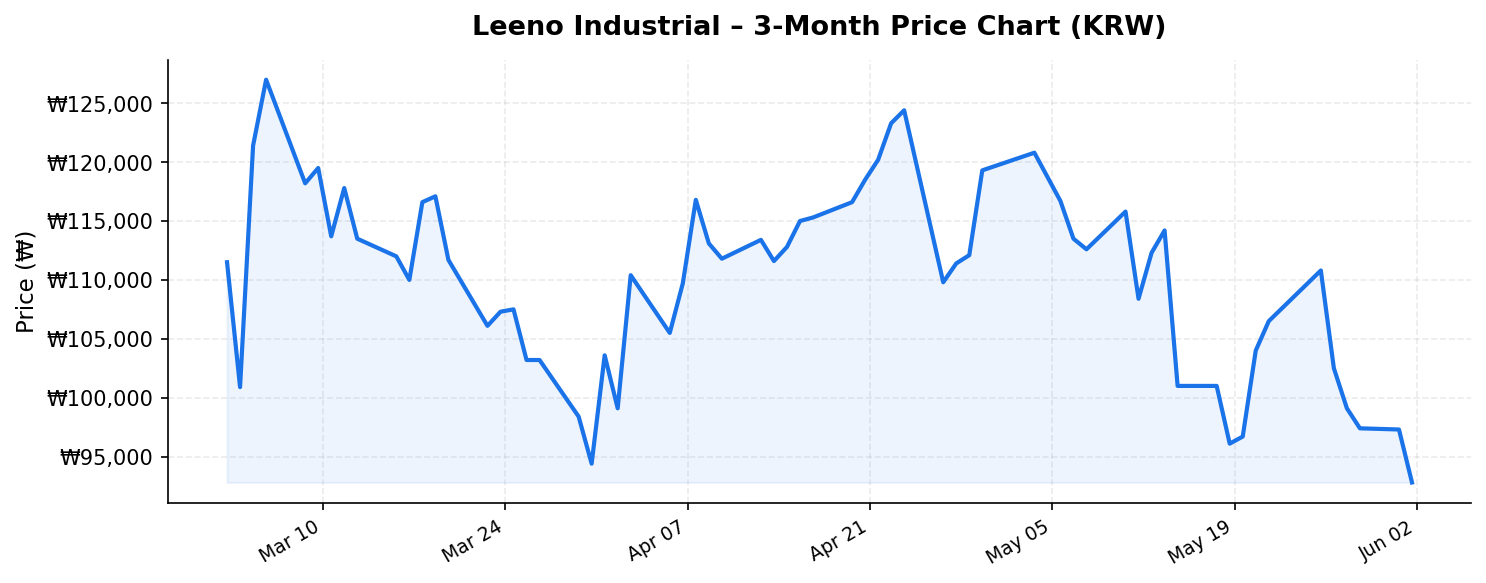
In a market where semiconductor-adjacent companies have been riding a historic wave of demand driven by AI infrastructure buildouts, few stories are as striking as Leeno Industrial (리노공업, 058470.KS). As of June 3, 2026, the stock trades at ₩219,500 — a figure that is not only 92.0% above its 52-week high of ₩114,300, but a staggering 540% above its 52-week low of ₩34,280. For international investors scanning the Korean market for semiconductor exposure beyond the usual mega-caps, Leeno Industrial demands serious attention — and serious scrutiny.
This analysis unpacks the company’s business fundamentals, competitive moat, the forces behind its parabolic price action, and the risks that come with investing at these elevated levels.

Business Overview: The Hidden Backbone of Semiconductor Testing
Leeno Industrial is a South Korean manufacturer specializing in test probes, test sockets, and precision contact pins used in the semiconductor testing process. Founded in 1978 and headquartered in Daegu, the company occupies a critical but often overlooked niche in the semiconductor value chain. Every chip — whether destined for a smartphone, a data center GPU, or an automotive ECU — must be electrically tested before it ships. Leeno’s products are the physical interface that makes this testing possible.
The company’s product portfolio breaks down into three main segments:
- Test probes (ICT probes): Used in printed circuit board (PCB) testing, these are Leeno’s legacy product line and remain a steady revenue contributor.
- Test sockets: Custom-designed sockets used to test semiconductor packages during the final test stage. This segment has been the primary growth driver in recent years.
- Precision contact pins and connectors: Specialized components serving both semiconductor and broader electronics applications.
What makes Leeno Industrial particularly compelling is its vertical integration. The company manufactures its own precision tooling and maintains tight control over its production processes, which allows it to achieve high margins in a segment where tolerances are measured in microns. Historically, the company has maintained operating margins in the 30-40% range — exceptional for a component maker and more in line with software-like profitability.

Competitive Position: A Small Company with an Outsized Moat
Leeno Industrial’s dominance in the test probe and socket market is built on several reinforcing competitive advantages that international investors should understand:
Technical precision as a barrier to entry. Manufacturing test probes for advanced semiconductor packages — particularly those used in high-bandwidth memory (HBM), advanced logic chips, and chiplet-based architectures — requires extreme precision engineering. As chip packaging has grown more complex (think 2.5D and 3D packaging for AI accelerators), the technical requirements for test interfaces have escalated dramatically. Leeno has spent decades accumulating process know-how that new entrants cannot easily replicate.
Deep customer relationships. Leeno counts the world’s leading outsourced semiconductor assembly and test (OSAT) companies, as well as major IDMs (integrated device manufacturers), among its customers. These relationships are sticky because test socket designs are often co-developed with customers and qualified alongside their specific production lines. Switching costs are meaningful — not because of price, but because of the risk and time involved in requalifying a new supplier.
Exposure to the AI semiconductor supercycle. The explosion in demand for AI training and inference chips — particularly from NVIDIA, AMD, and custom ASIC designers — has directly translated into higher testing volumes and, crucially, higher-complexity test sockets. HBM chips used in AI accelerators, for instance, require advanced test interfaces. As SK Hynix and Samsung ramp HBM3E and HBM4 production, Leeno is a direct beneficiary.
Market share leadership. In the global ICT probe market, Leeno is estimated to hold approximately 30-35% market share, making it the dominant player. In test sockets for semiconductor final test, it competes with Japanese firms like Yamaichi Electronics and Enplas, but has been steadily gaining share, particularly in high-growth AI and HBM-related applications.
Making Sense of the Valuation: Can the Numbers Justify ₩219,500?
The most pressing question for any investor looking at Leeno Industrial today is straightforward: how does one justify a stock trading 92% above its prior 52-week high?
Let’s put the price action in context. The 52-week range of ₩34,280 to ₩114,300 already represented a wide band — roughly a 3.3x spread from trough to peak. The current price of ₩219,500 represents nearly a complete doubling from that prior peak, suggesting that something fundamental has shifted in the market’s perception of Leeno’s earnings power.
Several factors likely explain this rerating:
- Earnings acceleration: If Leeno’s quarterly earnings have surprised significantly to the upside — driven by HBM and AI chip test demand — the stock may be pricing in a structurally higher earnings trajectory. For a company that historically traded at 20-30x forward earnings, a shift to a higher growth paradigm could justify multiple expansion alongside earnings growth.
- Scarcity premium: There are very few publicly listed pure-play semiconductor test probe companies globally. As international fund managers seek to build AI-themed portfolios, Leeno represents a rare and differentiated way to access the theme. Limited float and concentrated ownership can amplify price moves in such scenarios.
- Sector re-rating: The broader Korean semiconductor equipment and materials sector has experienced a significant re-rating as investors recognize Korea’s central role in HBM production and advanced packaging — areas where Leeno has direct exposure.
That said, trading at ₩219,500, the stock is likely commanding a trailing P/E ratio well north of 40-50x, depending on the latest reported earnings. International investors must ask whether Leeno can sustain revenue growth rates of 30%+ for multiple years to grow into this valuation. The bull case hinges on the AI capex cycle being durable and intensifying, with Leeno capturing an increasing share of a growing addressable market. The bear case is that testing demand is inherently cyclical, and any deceleration in AI chip production could trigger a sharp contraction in both earnings and multiples.
Dividend yield at these levels is almost certainly negligible. Leeno has historically paid modest dividends, but at a stock price of ₩219,500, the yield is likely well below 0.5%, making this purely a growth and capital appreciation story.
Key Risks International Investors Must Consider
Investing in a Korean small-to-mid-cap stock at all-time highs carries specific risks that deserve clear-eyed assessment:
- Cyclicality: The semiconductor industry is inherently cyclical. Test equipment and consumables demand can swing violently. Leeno’s margins, while excellent, are not immune to volume downturns. A correction in AI chip demand — even a temporary one — could disproportionately affect the stock at current valuations.
- Customer concentration: Leeno derives a significant portion of its revenue from a handful of major customers. Any loss of a key account or a strategic shift by a major OSAT or IDM could materially impact results.
- Currency risk: For international investors, the KRW/USD exchange rate adds another layer of volatility. A strengthening Korean won benefits foreign holders; a weakening won erodes returns regardless of stock performance.
- Liquidity and volatility: With a relatively modest market capitalization compared to Korean blue chips, Leeno Industrial can experience significant price swings. The move from ₩34,280 to ₩219,500 within the past year illustrates both the opportunity and the danger of this illiquidity premium.
- Competitive threats: Japanese competitors and emerging Chinese players could intensify competition, particularly if the test probe market becomes large enough to attract new investment. Additionally, changes in chip testing methodology (e.g., a shift toward built-in self-test or contactless testing at scale) could disrupt demand for physical probes.
- Geopolitical risk: Export controls and the broader U.S.-China technology rivalry could indirectly affect Leeno if its customers are impacted by restrictions on chip production or equipment sales to China.
Investment Thesis: A Premium Asset at a Premium Price
Leeno Industrial represents one of the highest-quality, most differentiated semiconductor component companies listed in Korea — or anywhere, for that matter. Its technical moat, market share leadership, and direct exposure to the most dynamic segments of the semiconductor industry (AI, HBM, advanced packaging) make it a genuinely compelling long-term holding for investors with conviction in the durability of the AI buildout.
However, the current price of ₩219,500 — sitting 92% above the prior 52-week high and over 6x the 52-week low — leaves virtually no margin of safety. This is a stock that has priced in not just the current cycle, but an optimistic view of cycles to come. For international investors considering an entry at these levels, position sizing discipline is paramount. This is a name to own, but the entry price matters enormously for risk-adjusted returns.
For those who already hold positions from lower levels, the decision is whether the AI semiconductor tailwind has further to run. The evidence so far suggests it does — but markets have a way of front-running even the strongest fundamental trends. A measured approach, perhaps involving partial profit-taking and maintaining a core position, may serve investors well.
Leeno Industrial is the kind of company that reminds us why deep research in overlooked corners of the Korean market can be so rewarding. The question today is not whether this is a great business — it clearly is. The question is whether ₩219,500 is a great price.

Disclaimer: This blog post is for informational and educational purposes only and does not constitute financial advice, investment advice, or a recommendation to buy, sell, or hold any security. The author may or may not hold positions in the securities discussed. Always conduct your own due diligence and consult a qualified financial advisor before making investment decisions. Past performance is not indicative of future results.