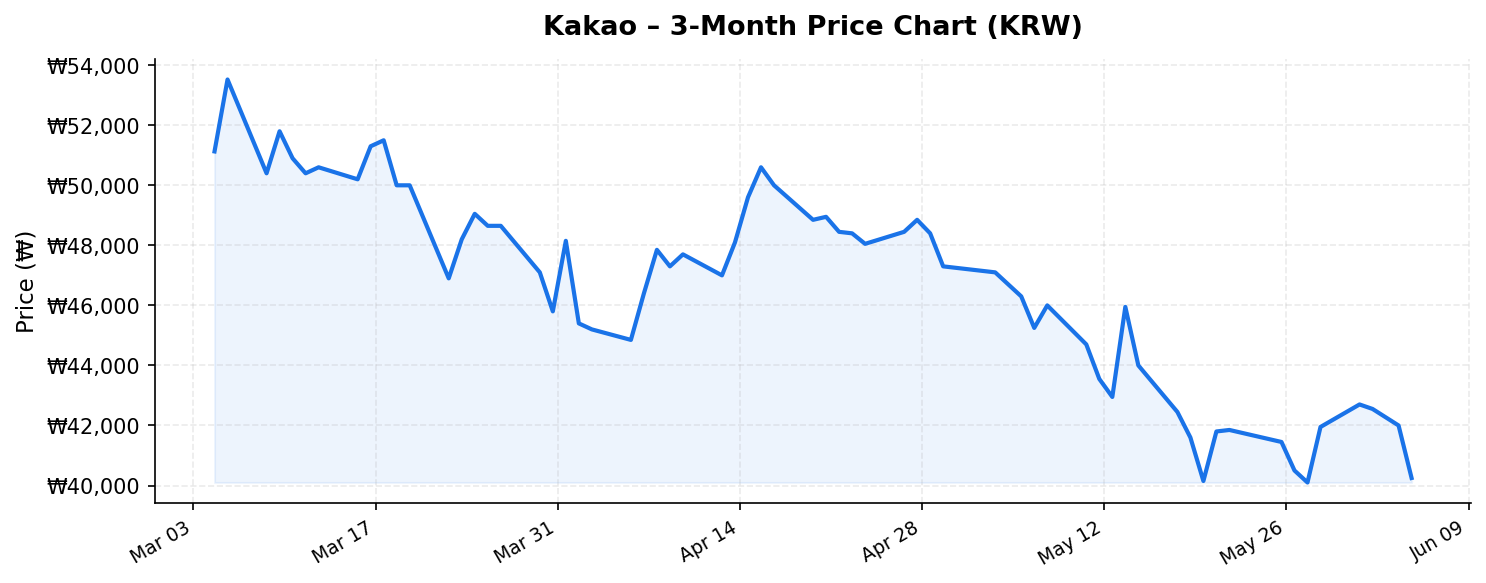
Few companies are as synonymous with daily life in South Korea as Kakao (카카오, 035720.KS). The operator of KakaoTalk — the messaging platform used by over 90% of the country’s population — has evolved into a sprawling digital conglomerate spanning fintech, mobility, entertainment, and AI. Yet as of June 5, 2026, Kakao’s stock sits at ₩40,300, a staggering 43.7% below its 52-week high of ₩71,600 and uncomfortably close to its 52-week low of ₩38,500. For international investors eyeing the Korean market, the question is unavoidable: is Kakao a deep value opportunity at these levels, or is the market telling us something fundamentally troubling?

Business Overview: Korea’s Digital Backbone Under Pressure
Kakao is not a single-product company. It is, in many ways, South Korea’s answer to a “super app” ecosystem. KakaoTalk, the core messaging platform, serves as a gateway to an enormous range of services — from mobile payments (KakaoPay) and digital banking (KakaoBank) to ride-hailing (Kakao Mobility), content streaming (Kakao Entertainment), and cloud/AI services. Revenue for the trailing twelve months stands at approximately ₩8.3 trillion (roughly $6.1 billion USD), reflecting the sheer breadth of its operations.
However, breadth has not translated into profitability efficiency. Kakao’s return on equity (ROE) sits at a modest 3.9%, a figure that would disappoint most growth-oriented tech investors. For context, major global peers in the platform economy — Meta, for instance — routinely post ROEs north of 20%. This signals that while Kakao generates significant top-line revenue, its capital allocation and margin structure leave much to be desired. The company’s aggressive expansion into multiple verticals, combined with regulatory headwinds and restructuring costs, has diluted returns on invested capital.
The market capitalization of ₩17.8 trillion (approximately $13 billion USD) prices Kakao at roughly 2.1x trailing revenue — a valuation that appears modest for a dominant platform company, but one that reflects the market’s skepticism about Kakao’s ability to convert revenue into sustainable, growing profits.

The Dividend Puzzle: What Does an 18% Yield Really Mean?
Perhaps the most eye-catching number in Kakao’s current data profile is the dividend yield of 18.00%. At first glance, this figure would make Kakao one of the highest-yielding major tech stocks in the world. But international investors should approach this number with extreme caution and analytical rigor.
An 18% dividend yield from a company with a 3.9% ROE is, mathematically, unsustainable over the long term unless the company is returning capital it doesn’t need — or paying out far more than it earns. There are several possible explanations that investors should investigate:
- Special or one-time dividends: Kakao may have issued a large special dividend related to asset sales, subsidiary IPOs, or restructuring activities. Korean conglomerates have increasingly used special dividends to return proceeds from divestitures to shareholders.
- Stock price collapse inflating the yield: With the share price down nearly 44% from its 52-week high, even a moderately sized dividend payment produces a dramatically elevated yield when expressed as a percentage of the depressed current price.
- Shareholder return policy shift: Korean regulators and the broader “Korea Discount” reform movement (the government’s Corporate Value-Up Program) have pressured companies to boost shareholder returns. Kakao may be responding to this pressure with an aggressive payout.
Regardless of the cause, international investors should not buy Kakao solely for the dividend yield. An 18% yield that proves to be a one-time event would evaporate as a thesis. What matters more is whether the underlying business can stabilize and grow earnings to support consistent, meaningful capital returns going forward.
Competitive Position and Regulatory Landscape
Kakao’s competitive moat remains formidable in several key areas. KakaoTalk’s dominance in South Korean messaging is virtually unassailable — no competitor, including global giants like WhatsApp or LINE, has managed to gain meaningful traction in the Korean market. This gives Kakao an entrenched distribution channel for financial services, commerce, and content that is nearly impossible to replicate.
KakaoPay and KakaoBank, both publicly listed subsidiaries, have become integral parts of South Korea’s fintech infrastructure. KakaoBank is one of the country’s largest digital-only banks by customer count, and KakaoPay processes a significant share of mobile transactions. Kakao Mobility, meanwhile, dominates the ride-hailing market in Korea with a near-monopoly position.
However, this dominance has attracted intense regulatory scrutiny. Over the past two years, Kakao has faced antitrust investigations, data privacy probes, and political pressure related to its market power. The 2022 data center fire — which knocked KakaoTalk offline for hours and disrupted national communications — remains a scar on the company’s reputation and led to increased government oversight. More recently, founder Kim Beom-su’s legal troubles related to stock manipulation allegations in the SM Entertainment acquisition have cast a long shadow over corporate governance perceptions.
For international investors, governance risk is a critical factor. Korean conglomerates have historically traded at a discount to global peers due to concerns about controlling shareholder actions, complex cross-holding structures, and opaque decision-making. Kakao is not immune to this “Korea Discount,” and its current valuation partly reflects these structural concerns.
Investment Thesis: Weighing the Bull and Bear Cases
The bull case for Kakao at ₩40,300 rests on several pillars:
- Depressed valuation: At 2.1x trailing revenue and near its 52-week low, much of the bad news appears priced in. The stock would need to rise approximately 78% just to revisit its 52-week high of ₩71,600.
- Irreplaceable platform: KakaoTalk’s grip on Korean digital life provides a durable competitive advantage that few global tech companies can match within a single national market.
- AI and new growth drivers: Kakao has been investing in AI capabilities, including large language models and AI-integrated services across its platform. If these investments begin to monetize effectively, they could re-accelerate growth.
- Korea Value-Up tailwinds: Government-driven reforms aimed at reducing the Korea Discount could lead to improved corporate governance, higher shareholder returns, and a structural re-rating of Korean equities, including Kakao.
- Sum-of-the-parts value: Kakao’s publicly listed subsidiaries (KakaoBank, KakaoPay, Kakao Entertainment) have independent market valuations. In some analyses, the combined value of these subsidiaries approaches or exceeds Kakao’s own market cap, implying the parent company’s core operations are being valued at near-zero.
The bear case, however, is equally compelling:
- Low profitability: A 3.9% ROE suggests the company is struggling to generate adequate returns. Without margin improvement, revenue growth alone won’t drive shareholder value.
- Regulatory overhang: Ongoing investigations and potential regulatory actions could result in fines, forced divestitures, or operational restrictions that materially impair the business.
- Governance concerns: The founder’s legal issues and the complex corporate structure create uncertainty that may keep institutional investors — particularly foreign ones — on the sidelines.
- Dividend sustainability: If the 18% yield reflects a non-recurring event, yield-seeking investors may sell once the reality becomes clear, putting further downward pressure on the stock.
- Macroeconomic headwinds: A slowing Korean economy, weak consumer spending, and a challenging advertising market could all weigh on Kakao’s near-term revenue trajectory.
For international investors, the risk-reward calculus depends heavily on time horizon and risk tolerance. Short-term traders face considerable uncertainty with the stock trading just 4.7% above its 52-week low of ₩38,500 — a level that, if breached, could trigger further technical selling. Long-term investors, on the other hand, may find the current setup attractive if they believe in Kakao’s platform durability and the potential for operational improvements.
Conclusion: A Complex Opportunity Requiring Patience and Due Diligence
Kakao at ₩40,300 is a company of contradictions: dominant market positions paired with low profitability, an eye-popping 18% dividend yield that may not be what it seems, and a deep discount to recent highs that reflects real — but potentially temporary — challenges. The ₩17.8 trillion market cap values one of Asia’s most entrenched digital ecosystems at a fraction of what global peers command, but that discount exists for reasons that international investors must understand fully before committing capital.
For those willing to do the work — parsing subsidiary valuations, tracking regulatory developments, and monitoring governance reforms — Kakao represents one of the more intellectually interesting opportunities in the Korean market today. But it is not a stock to buy on a headline dividend yield alone. The path to re-rating will require demonstrated improvement in ROE, clarity on regulatory matters, and evidence that Kakao’s sprawling empire can be managed for shareholder value, not just for scale.

Disclaimer: This blog post is for informational and educational purposes only and does not constitute financial advice, investment advice, or a recommendation to buy or sell any securities. All data is based on publicly available information as of June 5, 2026. Investors should conduct their own due diligence and consult with a qualified financial advisor before making any investment decisions. Investing in foreign equities involves additional risks, including currency fluctuation and geopolitical risk.