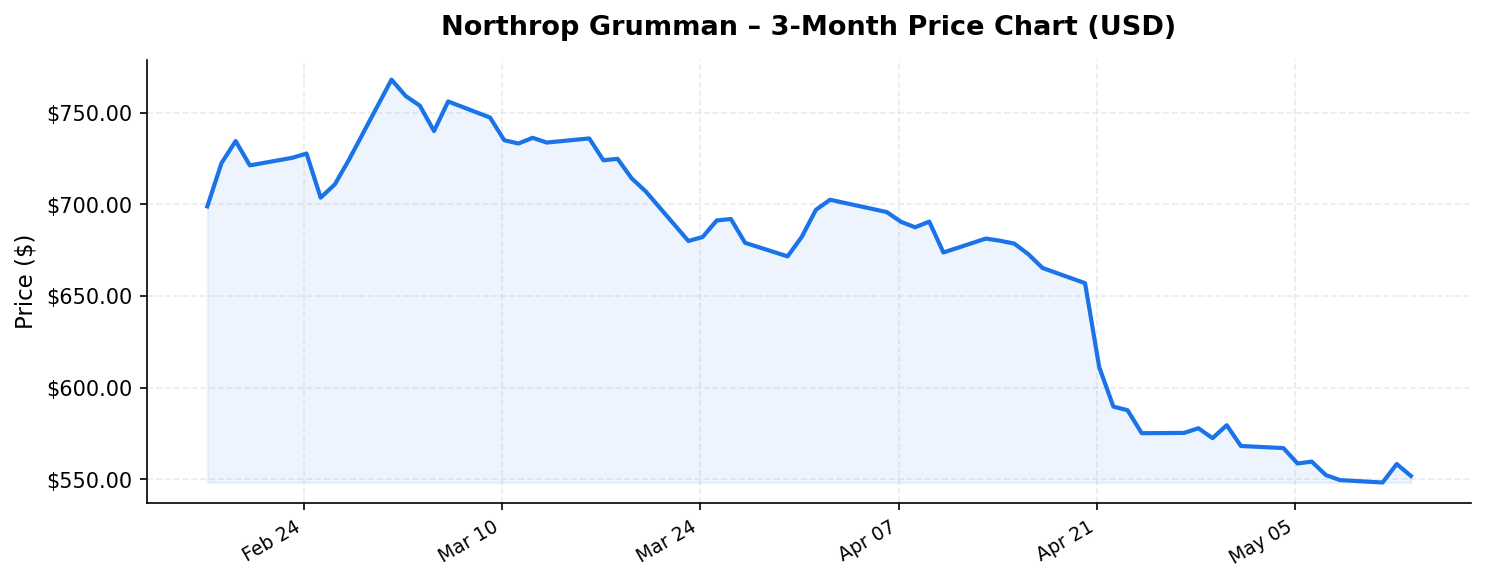
Defense stocks have long been considered a cornerstone of portfolio stability, particularly during periods of geopolitical uncertainty. Northrop Grumman (NOC), one of America’s largest defense contractors, currently trades at $551.80 — nearly 29% below its 52-week high of $774.00. For international investors watching the global defense spending surge, this pullback raises an urgent question: is Northrop Grumman now a compelling value opportunity, or is the decline signaling deeper structural concerns?
With a market capitalization of $78.4 billion, trailing twelve-month revenue of $42.4 billion, and what appears to be an extraordinarily generous dividend yield, Northrop Grumman demands careful, data-driven scrutiny. Let’s break down the fundamentals, competitive dynamics, risks, and investment case for global investors.
Business Overview: A Pillar of U.S. National Security
Northrop Grumman is one of the “Big Five” U.S. defense prime contractors, alongside Lockheed Martin, Raytheon Technologies, Boeing Defense, and General Dynamics. The company operates across four primary segments: Aeronautics Systems, Defense Systems, Mission Systems, and Space Systems. Its portfolio spans some of the most critical — and classified — programs in the U.S. defense apparatus.
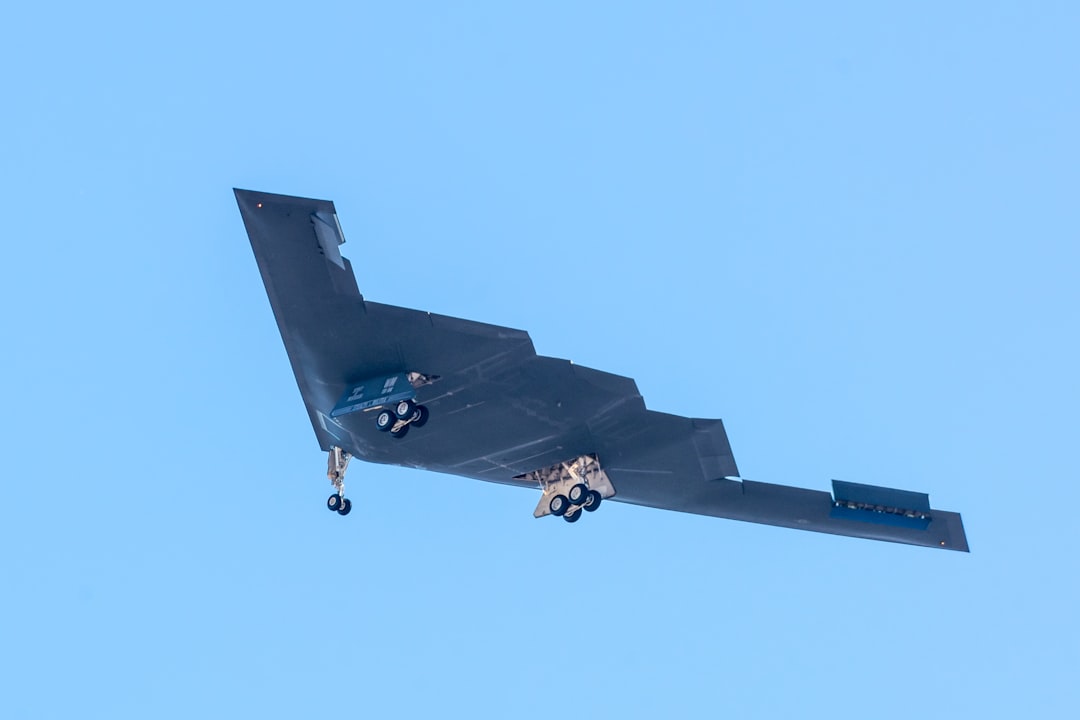
The company is the prime contractor for the B-21 Raider, the U.S. Air Force’s next-generation stealth bomber, widely regarded as one of the most important military aircraft programs of the 21st century. Northrop Grumman is also deeply embedded in the U.S. nuclear deterrence triad through its work on the Ground Based Strategic Deterrent (GBSD, now designated LGM-35A Sentinel) intercontinental ballistic missile program. Additionally, the company is a leading provider of autonomous systems, cyber solutions, space launch vehicles, and satellite systems.
With TTM revenue of $42.4 billion, Northrop Grumman has scaled significantly over recent years, driven by robust U.S. defense budgets and expanding international demand for advanced defense technologies. The company’s return on equity of 28.5% is notably strong for a capital-intensive industrial enterprise, signaling efficient capital allocation and solid profitability relative to shareholder equity.
Valuation Analysis: Bargain or Value Trap?
At a P/E ratio of 17.5x, Northrop Grumman trades at a reasonable multiple by historical defense sector standards. The broader S&P 500 typically commands a P/E in the 20-22x range, which means Northrop Grumman is priced at a meaningful discount to the market. For a company with deep competitive moats, decades-long contract backlogs, and strong government relationships, this valuation warrants attention.
The price-to-book ratio of 4.58x is elevated but not unusual for a defense prime contractor whose intangible assets — security clearances, intellectual property, classified program expertise, and institutional relationships — far exceed what balance sheet book value captures. Investors should evaluate this metric with the understanding that defense companies’ true competitive advantages rarely appear on their balance sheets.
The current price of $551.80 sits much closer to the 52-week low of $459.25 than the high of $774.00. Specifically, shares are approximately 20% above the 52-week low and nearly 29% below the peak. This positioning suggests the stock has already absorbed significant selling pressure, though it also means momentum has been decidedly negative.
Now, the headline dividend yield of 167.00% demands immediate clarification. This figure almost certainly reflects a data anomaly — possibly a special dividend, a one-time capital return event, or a data feed error. Northrop Grumman’s regular quarterly dividend has historically yielded in the range of 1.5% to 2.0% based on normal payout levels. International investors should verify the actual current annualized dividend per share before making income-based investment decisions. If the company did execute a massive special distribution, this could explain part of the share price decline from its 52-week high, as the stock would have been adjusted downward post-distribution. Regardless, Northrop Grumman has a strong track record of dividend growth, having increased its payout for over 20 consecutive years.
Competitive Position and Growth Catalysts
Northrop Grumman occupies a uniquely defensible competitive position, even among defense giants. Several structural advantages underpin this moat:
- Classified program dominance: A significant and growing portion of Northrop Grumman’s revenue comes from classified (“black”) programs. These programs carry extremely high barriers to entry, as competitors cannot simply bid on work without the requisite security infrastructure and clearances built over decades.
- B-21 Raider production ramp: As the B-21 transitions from development to production, Northrop Grumman stands to benefit from accelerating revenue and potentially improving margins as production efficiencies are realized. The U.S. Air Force plans to procure at least 100 aircraft, representing a multi-decade revenue stream.
- Nuclear modernization: The Sentinel ICBM program, despite facing cost overruns and schedule challenges, remains a national priority with no realistic alternative contractor. This provides Northrop Grumman with significant pricing power and long-term revenue visibility.
- Space and cyber growth: The company’s Space Systems segment is benefiting from the expansion of the U.S. Space Force and growing demand for satellite constellations, missile warning systems, and space launch capabilities. Cybersecurity and mission systems revenue also continues to grow as digital warfare becomes increasingly central to defense strategy.
- Allied defense spending surge: NATO allies, particularly in Europe and the Indo-Pacific, are dramatically increasing defense budgets in response to the Russia-Ukraine conflict and rising tensions with China. While Northrop Grumman’s international revenue share is smaller than some peers, the company is positioned to benefit from allied demand for advanced autonomous systems, sensors, and integrated defense solutions.
The combination of a $42.4 billion revenue base, high-barrier-to-entry programs, and a multi-decade backlog gives Northrop Grumman a level of revenue predictability that few industrial companies can match.
Key Risks International Investors Must Consider
No defense investment is without risk, and Northrop Grumman faces several material challenges that international investors should carefully weigh:
- U.S. budget and political risk: Approximately 85% of Northrop Grumman’s revenue comes from the U.S. government. Any significant shift in defense spending priorities, budget sequestration, or political pressure to reduce military outlays would directly impact the company. While bipartisan support for defense spending remains strong as of mid-2026, fiscal pressures from rising U.S. debt could introduce headwinds.
- Program execution risk: Large-scale defense programs are inherently complex. The Sentinel ICBM program has already experienced a Nunn-McCurdy breach (a cost overrun exceeding 25%), which triggered a mandatory review. While the program was restructured and continued, further cost growth could pressure margins and invite Congressional scrutiny.
- Currency risk for international investors: Since Northrop Grumman’s revenues and dividends are denominated in U.S. dollars, international investors bear currency translation risk. A strengthening home currency relative to the dollar would reduce the value of returns when converted back.
- Concentration risk: Heavy dependence on a single customer — the U.S. Department of Defense — creates vulnerability to policy shifts, continuing resolution budgets, and procurement delays that the company cannot control.
- Ethical and ESG considerations: For investors in jurisdictions with strong ESG mandates, Northrop Grumman’s involvement in nuclear weapons systems and autonomous weapons platforms may conflict with exclusionary screening criteria used by many European and Asian institutional investors.
Investment Thesis: Should International Investors Consider NOC?
The investment case for Northrop Grumman at current levels rests on a convergence of factors. A P/E of 17.5x for a company generating a 28.5% return on equity, with a multi-decade backlog of mission-critical defense programs, represents a potentially attractive entry point — particularly after the stock’s 29% decline from its 52-week high.
The global defense spending cycle remains firmly in expansion mode. NATO defense budgets are rising toward and beyond the 2% of GDP target, the U.S. continues to prioritize nuclear modernization and next-generation air power, and space and cyber domains are attracting rapidly growing investment. Northrop Grumman is positioned at the intersection of all three trends.
For income-oriented international investors, the company’s long history of dividend growth is appealing, though the reported 167% yield should be verified independently, as it likely reflects an extraordinary event rather than a sustainable payout level. The normal dividend yield, even if closer to the historical 1.5-2.0% range, combined with consistent buybacks, has delivered attractive total shareholder returns over the long term.
The primary risks — U.S. budget dependency, program execution, and currency exposure — are real but manageable for investors with a long time horizon and adequate portfolio diversification. Northrop Grumman’s competitive moats are among the deepest in the industrial sector, and its programs are deeply woven into U.S. national security in ways that make displacement by competitors extraordinarily unlikely.
At $551.80, Northrop Grumman appears to offer a compelling risk-reward profile for patient international investors seeking exposure to the secular growth in global defense spending, provided they are comfortable with the sector’s inherent political and ethical complexities.
Disclaimer: This article is for informational and educational purposes only and does not constitute financial, investment, or tax advice. The data presented reflects market conditions as of May 14, 2026, and may change. International investors should consult with qualified financial advisors in their respective jurisdictions before making any investment decisions. Past performance is not indicative of future results.