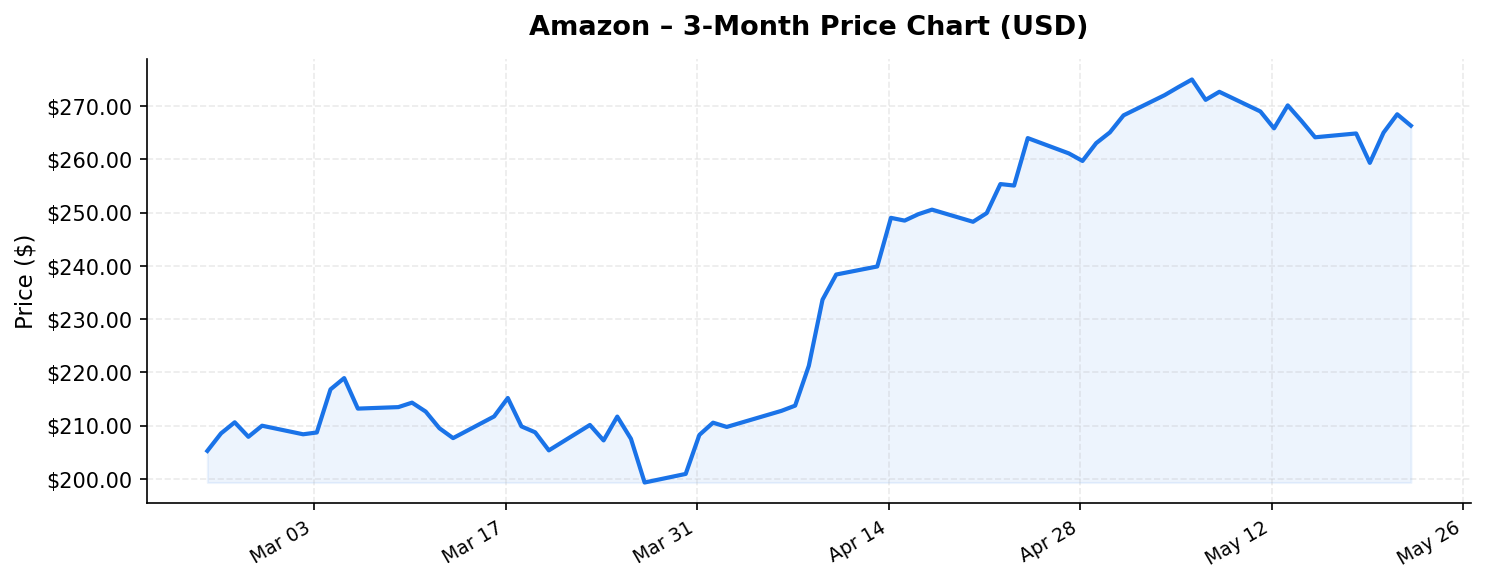
Amazon (AMZN) has quietly cemented itself as one of the most dominant companies in global commerce, cloud computing, and digital advertising. Trading at $266.32 as of May 25, 2026 — just 4.4% below its 52-week high of $278.56 — the stock reflects strong investor confidence in the company’s multi-engine growth model. With a staggering market capitalization of $2.9 trillion and trailing twelve-month revenue of $742.8 billion, Amazon stands as one of the largest publicly traded companies on the planet. But for international investors evaluating an entry point or considering adding to an existing position, the critical question remains: does the current valuation offer a compelling risk-reward profile, or has the market already priced in the best of what’s ahead?
In this analysis, we break down Amazon’s business fundamentals, competitive moat, key risks, and the investment case for global investors looking at U.S. equities in 2026.

Business Overview: Three Powerful Engines Driving $742.8 Billion in Revenue
Amazon’s business model is often misunderstood as simply an e-commerce company. While online retail remains its largest revenue contributor, the company has evolved into a diversified technology conglomerate with three primary growth engines: e-commerce and marketplace services, Amazon Web Services (AWS), and digital advertising.
The e-commerce and marketplace segment — encompassing both first-party retail and the massive third-party seller ecosystem — continues to generate the lion’s share of top-line revenue. Amazon’s logistics network, which now rivals the scale of UPS and FedEx in the United States, provides a nearly insurmountable structural advantage. The company’s ability to offer same-day and next-day delivery across hundreds of millions of items has set consumer expectations that competitors struggle to match. Internationally, Amazon continues to expand its fulfillment footprint across Europe, India, Latin America, and parts of Southeast Asia, providing a direct growth runway that global investors should monitor closely.
AWS, Amazon’s cloud computing division, remains the company’s most profitable segment. Despite increasing competition from Microsoft Azure and Google Cloud Platform, AWS continues to hold the leading market share in infrastructure-as-a-service (IaaS) and platform-as-a-service (PaaS). The secular shift toward cloud adoption, accelerated by enterprise AI workloads, positions AWS to sustain double-digit revenue growth for years to come. Critically, AWS generates operating margins that far exceed the rest of Amazon’s business, making it the primary driver of the company’s return on equity of 24.3% — a figure that reflects meaningful improvement from the mid-teens levels seen just a few years ago.
The third engine — advertising — has emerged as a high-margin revenue stream that leverages Amazon’s unmatched trove of purchase-intent data. Brands pay premium prices to reach consumers at the exact moment they’re ready to buy, giving Amazon an advertising proposition that rivals Meta and Google in terms of return on ad spend. This segment has been growing at rates north of 20% annually and contributes increasingly meaningful operating income.

Valuation Check: Is $266.32 a Fair Price for Amazon?
At a P/E ratio of 31.6x, Amazon trades at a premium to the broader S&P 500, which currently hovers around 22–24x trailing earnings. However, context matters enormously. Amazon’s P/E has compressed significantly from the 50–80x range that characterized much of the 2020–2023 period. This compression reflects not a deterioration in growth prospects but rather a dramatic expansion in profitability — particularly from AWS and advertising — that has finally allowed earnings to catch up with the stock’s valuation.
The price-to-book ratio of 6.48x is also worth examining. While this might appear elevated for a traditional retailer, Amazon is far from traditional. Its book value understates the true worth of intangible assets — the AWS customer base, Prime’s 200+ million global subscribers, the marketplace ecosystem, and the advertising platform. When viewed through the lens of a high-ROIC technology platform (return on equity stands at a robust 24.3%), a P/B of 6.48x is not unreasonable.
With the stock sitting at $266.32, Amazon is trading 35.9% above its 52-week low of $196.00 and just 4.4% below its 52-week high. This proximity to the high suggests that momentum remains positive, but it also means international investors entering now are not getting a bargain. The stock’s current position within its 52-week range implies that the market is largely pricing in continued strong execution. Any disappointment — whether from a deceleration in AWS growth, margin compression in retail, or macroeconomic headwinds — could trigger a meaningful pullback toward the $220–$240 range.
For income-focused international investors, it’s important to note that Amazon does not pay a dividend. The company reinvests virtually all free cash flow into growth initiatives, including AI infrastructure, logistics expansion, and content for Prime Video. This means that the investment thesis is entirely predicated on capital appreciation rather than yield, which may be a consideration for investors in markets where dividend income receives favorable tax treatment.
Competitive Position and Moat: Why Amazon Remains Hard to Displace
Amazon’s competitive moat is among the widest in global business, built on several reinforcing advantages:
- Scale and logistics: Amazon’s fulfillment network spans hundreds of facilities worldwide. The sheer capital expenditure required to replicate this infrastructure — estimated in the hundreds of billions of dollars — creates a near-impregnable barrier to entry for would-be competitors.
- Network effects: The marketplace model benefits from powerful network effects. More sellers attract more buyers, which attracts more sellers. This flywheel, first articulated by Jeff Bezos on a napkin, continues to spin faster with each passing year.
- Data advantage: Amazon possesses one of the richest datasets on consumer purchasing behavior in the world. This data fuels its advertising business, informs inventory decisions, and enables personalized recommendations that drive higher conversion rates.
- AWS ecosystem lock-in: Enterprise customers who build on AWS face significant switching costs. The deeper organizations integrate with AWS services — from machine learning tools to database management — the harder and more expensive it becomes to migrate to a competing platform.
- Prime membership: With over 200 million global subscribers, Prime creates a sticky, recurring revenue base while driving higher purchase frequency and cross-selling opportunities across Amazon’s ecosystem.
That said, competition is intensifying on multiple fronts. In cloud computing, Microsoft Azure continues to gain ground, particularly among enterprises already embedded in the Microsoft ecosystem. In e-commerce, Temu and Shein have disrupted the low-end market with ultra-cheap direct-from-China offerings, while Shopify empowers independent merchants to build their own branded storefronts. In AI, Google and Microsoft have made aggressive moves that challenge AWS’s dominance in the emerging generative AI infrastructure market.
Key Risks for International Investors
International investors considering Amazon should be mindful of several specific risks beyond the standard market volatility:
- Currency risk: Amazon shares are denominated in U.S. dollars. For investors whose home currency is the euro, yen, pound, or any other currency, fluctuations in the USD exchange rate can significantly impact returns — both positively and negatively. A strengthening dollar amplifies gains for foreign investors, while a weakening dollar erodes them.
- Regulatory risk: Amazon faces ongoing antitrust scrutiny in the United States, the European Union, and India. The FTC’s antitrust lawsuit, filed in 2023, remains a potential overhang. Any adverse ruling or forced structural changes — such as a separation of AWS from retail — could impact the stock, though some analysts argue a breakup might actually unlock shareholder value.
- Valuation risk: At 31.6x earnings, Amazon is priced for continued strong execution. Any meaningful deceleration in AWS growth, margin deterioration, or macroeconomic slowdown could result in multiple compression and a sharp price correction.
- Capital intensity: Amazon’s ongoing investments in AI data centers, satellite broadband (Project Kuiper), and logistics require enormous capital outlays. While these investments are expected to generate long-term returns, they suppress near-term free cash flow and introduce execution risk.
- U.S. withholding tax: International investors should be aware that while Amazon currently pays no dividend (making this a moot point today), any future capital gains or dividend initiations may be subject to U.S. withholding tax, depending on the investor’s country of residence and applicable tax treaties.
Investment Thesis: A Core Holding for Long-Term Global Portfolios
For international investors with a long-term horizon and tolerance for growth-stock volatility, Amazon presents a compelling — if not cheap — investment opportunity. The company’s $742.8 billion in trailing revenue, 24.3% return on equity, and dominant positions across e-commerce, cloud, and advertising create a diversified growth profile that few companies in the world can match.
The stock’s proximity to its 52-week high at $266.32 suggests that now is not an optimal time for aggressive accumulation. A more disciplined approach might involve building a position gradually through dollar-cost averaging, with a willingness to add more aggressively on any pullback toward the $220–$230 range — levels that would represent a P/E closer to 25x and offer a more attractive margin of safety.
Amazon’s lack of a dividend means the stock is best suited for growth-oriented portfolios rather than income strategies. For international investors seeking U.S. tech exposure with a diversified business model and a wide competitive moat, Amazon remains one of the most defensible names in the market — a company that, despite its massive size, continues to find new avenues for growth.
The $2.9 trillion market cap may seem daunting, but when supported by nearly three-quarters of a trillion dollars in annual revenue, industry-leading cloud infrastructure, and a relentless culture of innovation, it’s a valuation that the company has earned — and one it can continue to grow into.

Disclaimer: This article is for informational and educational purposes only and does not constitute financial advice. Investing in stocks involves risk, including the potential loss of principal. International investors should consult with a qualified financial advisor and consider their individual financial circumstances, tax obligations, and currency exposure before making any investment decisions.