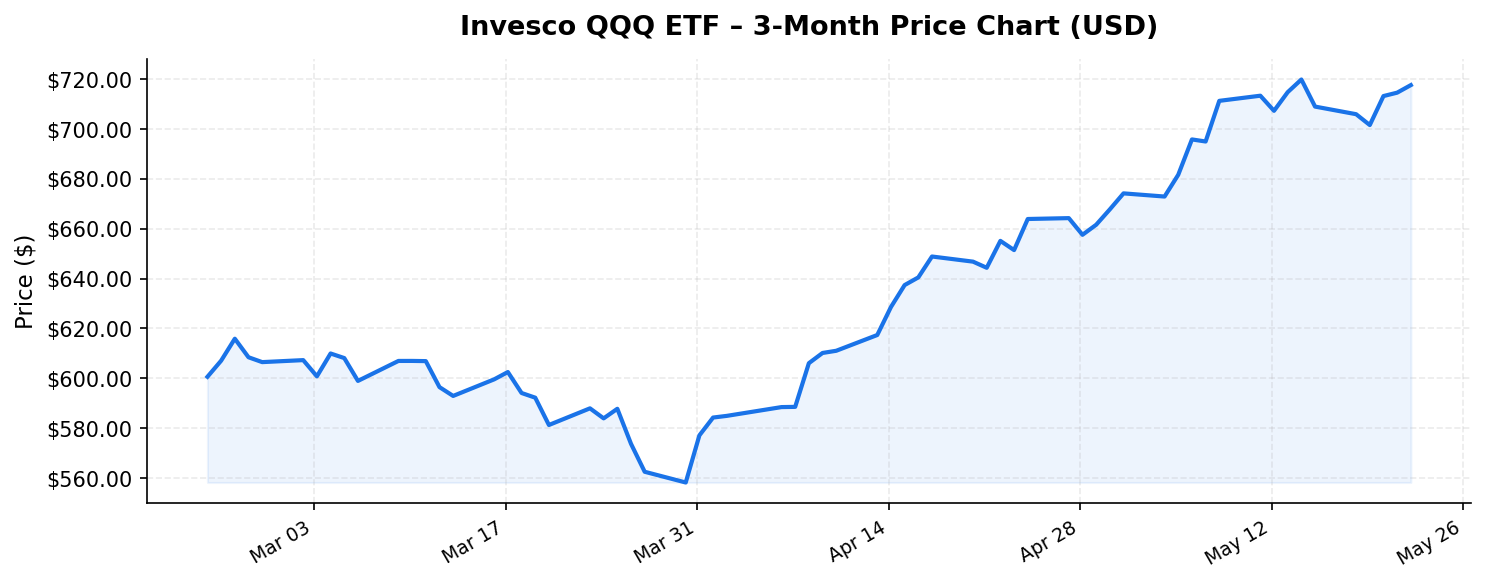
As of May 26, 2026, the Invesco QQQ ETF (QQQ) is trading at $717.54 — just 0.6% below its 52-week high of $722.12. For international investors seeking exposure to the most innovative and dominant technology companies in the United States, QQQ has long been one of the most popular vehicles. But with a price-to-earnings ratio of 35.0x and a staggering reported dividend yield of 42.00% that demands closer scrutiny, the question is whether now is the right time to allocate capital to this benchmark ETF. In this analysis, we’ll break down the fund’s composition, valuation dynamics, key risks, and the investment case for global investors.

What Is QQQ and Why Does It Matter to Global Investors?
The Invesco QQQ ETF tracks the Nasdaq-100 Index, a market-capitalization-weighted index comprising 100 of the largest non-financial companies listed on the Nasdaq Stock Exchange. This means the fund is heavily tilted toward technology, communication services, and consumer discretionary sectors — the engines of American innovation and global digital infrastructure.
Top holdings typically include mega-cap names like Apple, Microsoft, NVIDIA, Amazon, Meta Platforms, Alphabet, and Broadcom. These companies are not just American enterprises; they are global juggernauts whose revenues span every continent. For an international investor in Tokyo, London, Mumbai, or São Paulo, owning QQQ is effectively owning a diversified slice of the companies that power the world’s digital economy.
With approximately $300 billion in assets under management and among the highest daily trading volumes of any ETF globally, the Invesco QQQ ETF offers exceptional liquidity — a critical consideration for international investors who may face currency conversion costs and need the ability to enter or exit positions efficiently. Its expense ratio of 0.20% remains competitive for a fund of its caliber, though cheaper Nasdaq-100 alternatives have emerged in recent years.
Valuation Check: What the Numbers Tell Us at $717.54
At its current price of $717.54, the Invesco QQQ ETF sits remarkably close to the top of its 52-week range of $511.93 – $722.12. This means the fund has rallied approximately 40% from its 52-week low and is now within striking distance of new all-time highs. This kind of momentum is a double-edged sword: it reflects strong investor confidence in the underlying holdings, but it also raises the question of how much upside remains in the near term.
The fund’s P/E ratio of 35.0x is elevated relative to the broader S&P 500 (which typically trades closer to 20-22x), but it is broadly in line with historical norms for the Nasdaq-100. Investors are paying a premium for above-average earnings growth, and the constituent companies have largely delivered on that promise. The artificial intelligence boom, cloud computing expansion, and digital advertising recovery have all fueled robust earnings growth across QQQ’s top holdings through 2025 and into 2026.
The P/B ratio of 2.01x is interesting and warrants context. Many of QQQ’s largest holdings are asset-light technology businesses where book value is a less meaningful metric. A P/B of 2.01x for a tech-heavy portfolio is actually relatively modest, suggesting that despite the elevated P/E, investors are not paying an extreme premium relative to the tangible and intangible assets on these companies’ balance sheets.
Now, the reported dividend yield of 42.00% is almost certainly a data anomaly or reflects a special distribution event rather than a sustainable ongoing yield. Historically, the Invesco QQQ ETF yields somewhere between 0.5% and 0.8% annually, as its constituent companies tend to reinvest earnings into growth rather than distribute them as dividends. International investors should treat this figure with extreme caution and verify the distribution history before making any income-based investment decisions. It is possible that a large capital gains distribution, index reconstitution event, or data reporting error is responsible for this outlier figure. The fund has never been — and is unlikely to be — a high-income investment vehicle.
Competitive Position and the AI-Driven Growth Thesis
What sets the Invesco QQQ ETF apart from broader market ETFs like the SPDR S&P 500 ETF (SPY) or the Vanguard Total Stock Market ETF (VTI) is its concentrated exposure to secular growth themes. As of mid-2026, three dominant tailwinds continue to drive the Nasdaq-100’s outperformance:
- Artificial Intelligence Infrastructure: NVIDIA, Broadcom, and AMD — all top QQQ holdings — are at the epicenter of the AI hardware buildout. Enterprise spending on AI infrastructure has shown no signs of slowing, and these companies continue to post triple-digit or high double-digit revenue growth in their data center segments.
- Cloud Computing Maturation: Microsoft Azure, Amazon Web Services, and Google Cloud collectively dominate the global cloud market. As enterprises worldwide continue migrating workloads to the cloud, these platforms generate recurring, high-margin revenue streams that underpin QQQ’s earnings growth.
- Digital Advertising Resilience: Meta Platforms and Alphabet have demonstrated that AI-enhanced ad targeting can drive revenue growth even in uncertain macroeconomic environments. Their combined advertising revenues represent a significant portion of QQQ’s earnings base.
For international investors, this concentration is both QQQ’s greatest strength and its primary structural risk. The fund gives you a front-row seat to America’s most dynamic growth companies, but it does so without the diversification benefits of financials, energy, healthcare, or industrials that broader indices provide.
Compared to alternatives like the iShares MSCI World ETF or regional technology funds, the Invesco QQQ ETF offers unmatched depth of exposure to U.S. mega-cap tech. No other single country or region has produced a comparable cluster of dominant technology platforms, and QQQ remains the most efficient way to access them.
Key Risks International Investors Must Consider
While the bullish case for the Invesco QQQ ETF is compelling, international investors face a unique set of risks that domestic U.S. investors may not fully appreciate:
- Currency Risk: QQQ is denominated in U.S. dollars. For investors whose home currency is the euro, yen, pound, or any emerging market currency, fluctuations in the USD can significantly amplify or erode returns. The dollar’s strength in recent years has been a tailwind for international holders, but this can reverse quickly. Hedged share classes or currency overlay strategies may be worth considering.
- Concentration Risk: The top 10 holdings in the Nasdaq-100 often account for over 50% of the index’s total weight. A significant earnings miss or regulatory action against any single mega-cap company could have an outsized impact on the fund’s performance. This is not a broadly diversified portfolio.
- Valuation Risk: At 35.0x earnings, there is limited margin of safety if earnings growth disappoints. A reversion to a more normalized P/E of 25-28x — without corresponding earnings growth — could imply a 15-25% drawdown from current levels. The fund’s proximity to its 52-week high of $722.12 suggests limited room for multiple expansion.
- Regulatory and Geopolitical Risk: U.S.-China tensions, semiconductor export controls, antitrust actions against big tech, and evolving AI regulation all represent tail risks that could disrupt the earnings trajectories of QQQ’s largest constituents. International investors should monitor U.S. policy developments closely.
- Withholding Tax on Distributions: Non-U.S. investors are typically subject to a 30% withholding tax on dividends paid by U.S. ETFs, unless reduced by a tax treaty. While QQQ’s normal dividend yield is low (making this less impactful than for high-yield funds), the tax drag is still a consideration for total return calculations.
Investment Thesis: Should International Investors Buy QQQ at $717.54?
The investment case for the Invesco QQQ ETF ultimately comes down to conviction in the durability of American technology leadership. At $717.54, just below its 52-week peak, this is not a bargain-basement entry point. Investors buying today are paying full price for a portfolio of exceptional businesses with strong competitive moats and robust growth trajectories.
For long-term international investors with a 5-10 year horizon, QQQ remains one of the most compelling ways to participate in the AI revolution, cloud computing expansion, and the broader digitization of the global economy. The fund’s track record of outperforming broader indices over the past decade-plus speaks to the structural advantages of its holdings.
However, tactical investors or those with shorter time horizons should be cautious. The 40% rally from the 52-week low of $511.93 has been swift, and the 35.0x P/E leaves limited room for disappointment. A dollar-cost averaging approach — investing fixed amounts at regular intervals — may be the most prudent strategy for international investors looking to build a position without timing risk.
The anomalous 42.00% dividend yield figure should be investigated independently before any investment decision. Do not rely on this number as representative of the fund’s income-generating potential. QQQ is a growth vehicle, not an income vehicle, and should be positioned accordingly within a diversified portfolio.
In summary, the Invesco QQQ ETF at current levels offers premium exposure to the world’s most innovative companies at a premium valuation. For international investors who understand the currency, concentration, and valuation risks involved, it remains a cornerstone holding for technology-driven growth. Just don’t expect it to be a smooth ride.
Disclaimer: This blog post is for informational and educational purposes only and does not constitute financial advice, investment advice, or a recommendation to buy or sell any securities. All data referenced is as of May 26, 2026, and may change. Investors should conduct their own due diligence and consult with a qualified financial advisor before making any investment decisions. Past performance is not indicative of future results.