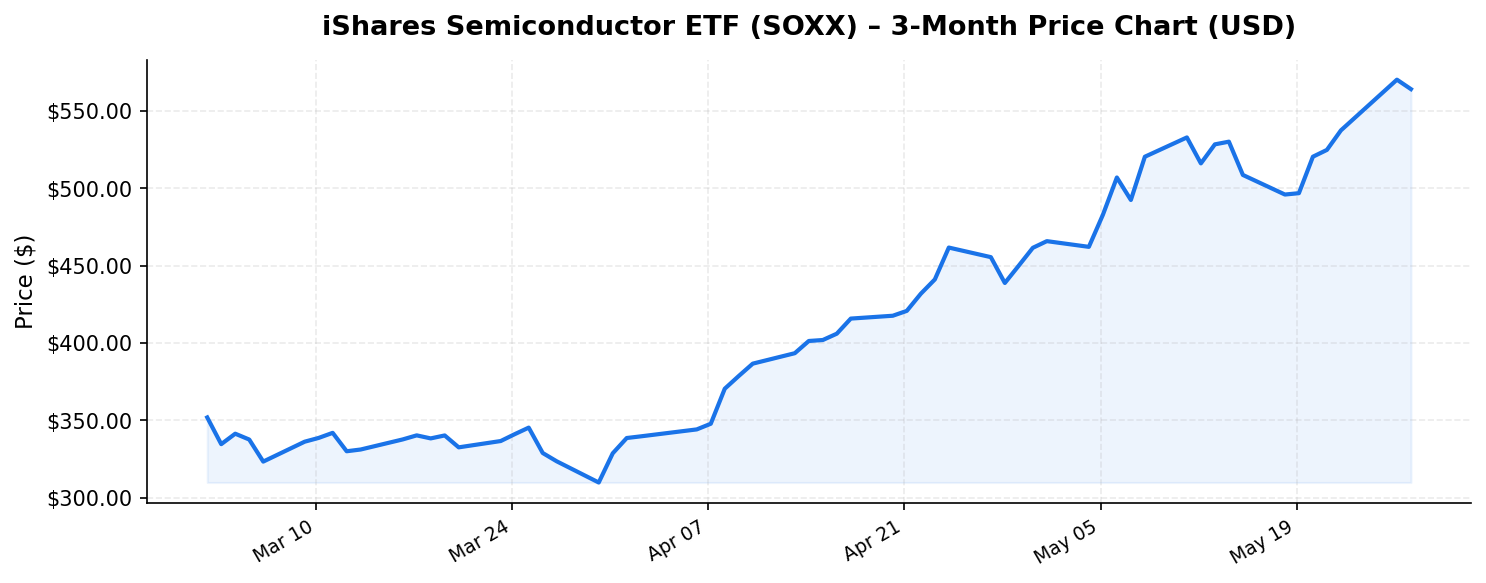
The semiconductor industry has been one of the defining investment themes of the 2020s, fueled by the explosive growth of artificial intelligence, cloud computing, autonomous vehicles, and the broader digitization of the global economy. For international investors seeking diversified exposure to this critical sector, the iShares Semiconductor ETF (SOXX) (SOXX) has long served as a premier vehicle. But with the ETF trading at $563.98 — just 3.5% below its 52-week high of $584.50 — and carrying a price-to-earnings ratio of 51.8x, the question on every investor’s mind is whether the valuation is justified or whether the easy money has already been made.
In this analysis, we’ll break down the fund’s composition, evaluate its valuation metrics, examine the risks facing the semiconductor sector, and build a nuanced investment thesis for international investors considering an allocation to iShares Semiconductor ETF (SOXX) in late May 2026.

What Is SOXX and Why Does It Matter?
The iShares Semiconductor ETF (SOXX) is an exchange-traded fund managed by BlackRock that tracks the ICE Semiconductor Index. It provides concentrated exposure to approximately 30 of the largest U.S.-listed semiconductor companies, spanning the entire chip value chain — from designers and manufacturers to equipment makers and specialty analog firms. Top holdings have historically included names like NVIDIA, Broadcom, AMD, Texas Instruments, Qualcomm, Applied Materials, and ASML (via its U.S. listing).
What makes SOXX particularly relevant for international investors is that it offers a single-ticket gateway to the most strategically important technology subsector in the world. Semiconductors are the foundation of virtually every technological advancement, from AI training clusters consuming tens of thousands of GPUs to the humble sensors in an electric vehicle. The fund’s modified market-cap weighting methodology prevents excessive concentration in any single name, offering a more balanced risk profile than buying individual chip stocks outright.
The ETF’s 52-week range tells a dramatic story: from a low of $201.12 to its current level near $564, SOXX has delivered a staggering recovery — nearly tripling from its trough. This range reflects the extreme volatility that semiconductor stocks can exhibit, driven by cyclical demand patterns, geopolitical disruptions, and rapidly shifting investor sentiment around AI monetization timelines.

Valuation Deep Dive: What Do the Numbers Tell Us?
At a P/E ratio of 51.8x, iShares Semiconductor ETF (SOXX) is trading at a significant premium to the broader S&P 500, which has historically averaged between 18x and 22x earnings. However, context matters enormously when evaluating semiconductor valuations. The sector’s earnings are highly cyclical, and during periods of heavy capital expenditure — such as the current AI infrastructure buildout — forward earnings growth expectations can justify elevated multiples.
Several key considerations for international investors evaluating this P/E:
- Earnings growth trajectory: Many of SOXX’s top holdings are projecting 25-40% earnings growth over the next 12-18 months, driven by AI datacenter demand, the ramp of next-generation chip nodes, and recovering consumer electronics markets. If these growth rates materialize, the forward P/E compresses significantly.
- Cyclical positioning: Semiconductor cycles typically last 3-5 years. With the AI-driven supercycle still in its relative early-to-mid stages, many analysts argue that peak earnings are still ahead, which would bring the multiple down even at current prices.
- Premium vs. history: SOXX has traded at elevated P/E multiples during previous innovation cycles (e.g., the 5G buildout in 2020-2021). A 50x+ multiple is not unprecedented during periods of structural demand acceleration.
The price-to-book ratio of 1.33x, however, stands out as surprisingly modest. This figure suggests that despite the lofty earnings multiple, the underlying companies in the ETF carry substantial tangible and intangible asset bases — including multi-billion-dollar fabrication facilities, extensive patent portfolios, and significant intellectual property. For value-conscious international investors, a P/B of 1.33x provides some comfort that the ETF is not purely priced on speculative earnings projections.
Perhaps the most eye-catching data point is the dividend yield of 36.00%. This extraordinarily high yield warrants careful interpretation. It likely reflects significant special distributions, capital gains payouts, or a return-of-capital event rather than a sustainable recurring dividend yield. International investors should investigate the composition of these distributions carefully, as tax treatment varies substantially by jurisdiction. For investors in countries with favorable U.S. tax treaty provisions, a portion of these distributions could be highly tax-efficient — but for others, U.S. withholding taxes of up to 30% could significantly erode the net yield. Regardless, this level of distribution makes SOXX unusually attractive from an income perspective in a sector not traditionally known for generous payouts.
Key Risks: What Could Go Wrong?
Despite the compelling growth narrative, international investors must weigh several material risks before allocating capital to iShares Semiconductor ETF (SOXX) at these elevated levels.
1. Geopolitical risk and export controls: The semiconductor industry sits at the epicenter of U.S.-China strategic competition. Ongoing and potentially escalating export restrictions on advanced chip technology to China directly impact the revenue lines of major SOXX holdings. Companies like NVIDIA and Applied Materials have already seen billions in lost Chinese revenue due to export controls. Any further tightening — or retaliatory measures from China — could materially impact sector earnings.
2. Cyclical downturn risk: While the current AI-driven demand cycle appears robust, semiconductor stocks are inherently cyclical. Inventory buildups, demand plateaus in AI spending, or a broader economic slowdown could trigger a sharp correction. The ETF’s 52-week low of $201.12 — representing a 64% decline from current levels — serves as a sobering reminder of how quickly sentiment can reverse in this sector.
3. Concentration and sector risk: SOXX is a sector-specific ETF, meaning it offers zero diversification across industries. A portfolio heavily weighted toward semiconductors is vulnerable to sector-wide shocks — whether from technological disruption, regulatory changes, or shifts in capital spending patterns among hyperscale cloud customers.
4. Valuation compression: At 51.8x earnings, even modest disappointments in growth expectations could trigger meaningful multiple contraction. If the market decides that AI monetization timelines are extending or that chip companies’ pricing power is eroding, a P/E re-rating from 50x to 35x would imply a 30% decline even with stable earnings.
5. Currency risk for international investors: SOXX is denominated in U.S. dollars. International investors must account for foreign exchange risk, particularly if the dollar weakens against their home currency. A strong U.S. dollar environment has historically supported foreign inflows into U.S. tech assets, but any reversal could create a headwind for non-dollar-denominated returns.
Investment Thesis: Should International Investors Buy SOXX Here?
The investment case for iShares Semiconductor ETF (SOXX) ultimately comes down to one’s conviction in the durability and scale of the AI-driven semiconductor supercycle. Let’s frame the bull and bear cases:
The bull case: We are still in the early innings of a multi-year, potentially multi-trillion-dollar infrastructure buildout across AI training, AI inference, edge computing, and autonomous systems. Semiconductor companies are the primary beneficiaries of this spending, with expanding margins and record backlogs. The current 51.8x P/E will look reasonable in hindsight if earnings double over the next 2-3 years, as many analysts project. The exceptional 36% distribution yield — even if partially driven by one-time events — adds a meaningful income component that is rare in growth-oriented technology investing. At just 3.5% below its 52-week high, the ETF is demonstrating strong technical momentum, suggesting institutional conviction remains robust.
The bear case: The massive run from the 52-week low of $201.12 to nearly $564 means that much of the good news is already priced in. At 51.8x earnings, there is minimal margin of safety, and any disappointment in AI revenue trajectories could trigger a violent correction. Geopolitical risks are real and largely unpriced. The extraordinary dividend yield may not be repeatable, potentially creating a yield trap for income-seeking investors who extrapolate it forward.
For international investors specifically, a few additional considerations apply. First, SOXX provides exposure to a sector where U.S. companies maintain dominant global market share — a structural advantage that is difficult to replicate through domestic markets in most countries. Second, the ETF structure provides instant diversification across 30 chip companies, reducing single-stock risk that would be amplified when investing from abroad. Third, the current price level — while elevated — is supported by fundamental earnings growth rather than purely speculative exuberance, which distinguishes this cycle from previous technology bubbles.
A prudent approach for international investors might involve dollar-cost averaging into a position over 3-6 months rather than making a single lump-sum investment at current levels. This strategy would help mitigate timing risk given the sector’s inherent volatility, while still securing exposure to what remains the most consequential technology investment theme of this decade.
Conclusion
The iShares Semiconductor ETF (SOXX) at $563.98 represents a compelling but complex opportunity for international investors. The fundamental demand drivers are powerful and likely durable, the fund provides diversified access to the world’s most strategically important technology subsector, and the current distribution yield adds an unusual income dimension. However, the 51.8x P/E ratio leaves little room for error, the 180%+ rally from 52-week lows introduces significant mean-reversion risk, and geopolitical headwinds remain a persistent overhang. For investors with a multi-year horizon, strong risk tolerance, and conviction in the AI infrastructure thesis, SOXX deserves serious consideration as a core technology allocation — but position sizing and entry strategy will be critical to managing downside risk in what remains one of the market’s most volatile sectors.
Disclaimer: This article is for informational and educational purposes only and does not constitute financial advice, a recommendation, or a solicitation to buy or sell any securities. Investors should conduct their own due diligence and consult with a qualified financial advisor before making investment decisions. Past performance is not indicative of future results. International investors should also consider tax implications, currency risk, and regulatory factors specific to their jurisdiction.