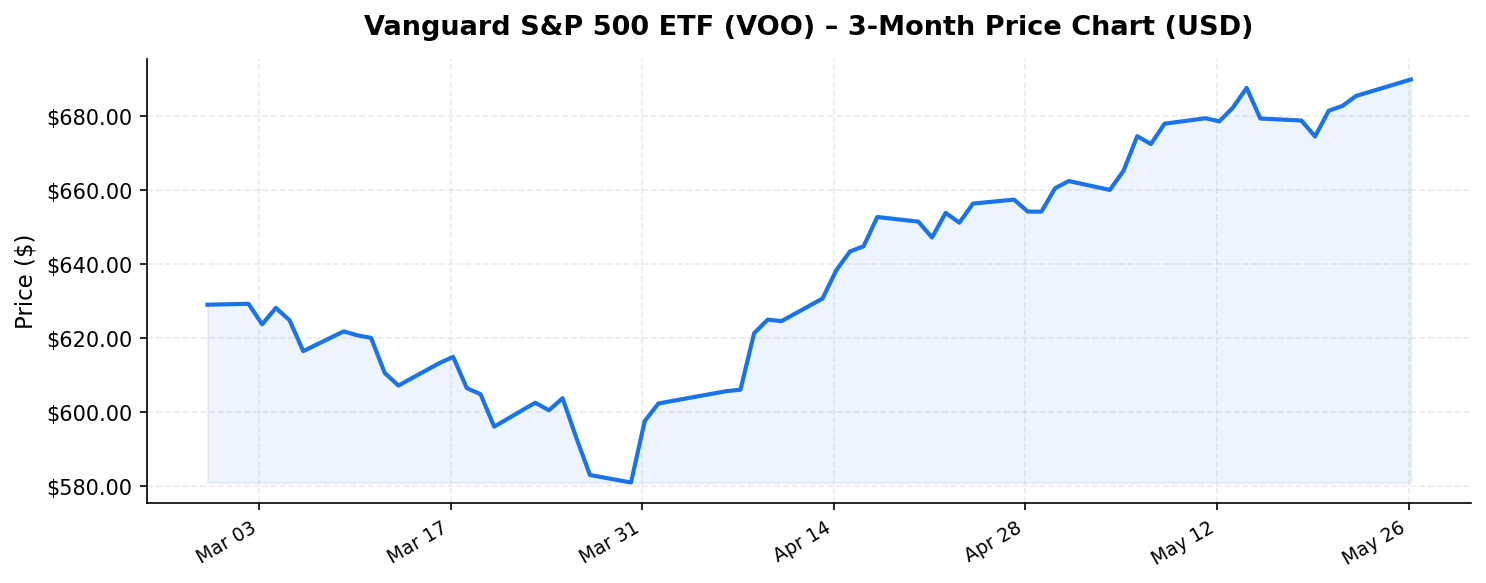
For international investors seeking broad exposure to the United States equity market, few instruments have proven as reliable and cost-effective as the Vanguard S&P 500 ETF (VOO) (VOO). Trading at $690.01 as of May 27, 2026 — a mere 0.2% below its 52-week high of $691.51 — the fund is knocking on the door of new highs and commanding the attention of global allocators. But does the current valuation still offer a compelling entry point, or are international investors late to the party? In this data-driven analysis, we break down the ETF’s fundamentals, competitive positioning, key risks, and the investment thesis for non-U.S. investors considering an allocation today.
What Is Vanguard S&P 500 ETF (VOO) and Why Does It Matter?
The Vanguard S&P 500 ETF (VOO) is a passively managed exchange-traded fund that tracks the S&P 500 Index, a market-capitalization-weighted benchmark comprising 500 of the largest publicly traded companies in the United States. Launched in 2010 by Vanguard — the pioneer of low-cost index investing — VOO has grown into one of the world’s most widely held ETFs, with hundreds of billions of dollars in assets under management.
For international investors, VOO serves as a single-ticket gateway to the American economy. Its holdings span every major sector, from technology giants like Apple, Microsoft, and NVIDIA to healthcare leaders like UnitedHealth Group and Johnson & Johnson, financial powerhouses like JPMorgan Chase, and consumer staples stalwarts like Procter & Gamble. This diversification across approximately 500 companies means that VOO effectively represents the heartbeat of U.S. corporate earnings — and, by extension, a significant share of global economic output.
One of VOO’s defining advantages is its ultra-low expense ratio, typically around 0.03%, making it one of the cheapest ways to access the U.S. market. For international investors who may face additional costs such as currency conversion fees, foreign brokerage commissions, and withholding taxes on dividends, keeping the fund-level expense as low as possible is critical to preserving long-term returns.
Valuation Check: Is VOO Fairly Priced Near All-Time Highs?
With a current price of $690.01, VOO sits just $1.50 below its 52-week high of $691.51 — a gap of only 0.2%. This proximity to highs naturally raises the question of whether the market is overextended. However, context matters. VOO’s 52-week low of $536.16 means the fund has rallied approximately 28.7% from its trough, reflecting a powerful recovery and sustained bullish momentum throughout much of the past year.
The fund’s price-to-earnings (P/E) ratio of 28.2x is above the S&P 500’s long-term historical average of roughly 16-17x, signaling that the market is pricing in robust future earnings growth. This elevated multiple is driven in large part by the outsized weighting of high-growth technology and AI-related companies within the index. While a 28.2x P/E may give value-oriented investors pause, it’s worth noting that this level has been the “new normal” for much of the post-2020 era, as mega-cap tech companies with exceptional margins and growth profiles have come to dominate index composition.
The price-to-book (P/B) ratio of 1.77x provides an additional lens into valuation. While not excessively high in absolute terms, this figure reflects the increasing importance of intangible assets — intellectual property, brand value, software platforms — that don’t always appear on traditional balance sheets. For international investors accustomed to markets where P/B ratios may be closer to 1.0x (such as many European or Asian markets), the 1.77x figure underscores the premium the market places on U.S. corporate innovation and earnings power.
A critical data point that requires careful interpretation is the reported dividend yield of 108.00%. This figure is almost certainly a data anomaly — likely reflecting a special distribution, a capital gains payout, a data feed error, or a recalculation artifact. Historically, VOO’s dividend yield has hovered in the range of 1.2% to 1.8%, consistent with the S&P 500’s aggregate yield. International investors should verify this number through their brokerage platform or Vanguard’s official site before making any income-based investment decisions. Assuming a more typical yield of approximately 1.3-1.5%, VOO offers modest but reliable income, with the primary return driver being long-term capital appreciation.
Competitive Position: Why VOO Stands Out in a Crowded ETF Landscape
The S&P 500 ETF space is fiercely competitive, with VOO facing direct competition from the SPDR S&P 500 ETF Trust (SPY) and the iShares Core S&P 500 ETF (IVV). All three funds track the same index and deliver nearly identical returns over time. However, several factors give VOO an edge, particularly for cost-conscious international investors:
- Expense Ratio: VOO’s expense ratio of approximately 0.03% is among the lowest in the industry, matching IVV and undercutting SPY’s 0.0945%. Over a multi-decade investment horizon, these seemingly small differences compound meaningfully. On a $100,000 investment over 30 years, the expense difference between VOO and SPY could amount to thousands of dollars.
- Vanguard’s Unique Structure: Vanguard’s mutual ownership structure means the company is owned by its funds, which are in turn owned by their shareholders. This alignment of interests has historically translated into relentless cost reduction and investor-friendly policies.
- Tax Efficiency: VOO benefits from Vanguard’s patented ETF-as-a-share-class structure, which can minimize capital gains distributions — a particularly important consideration for international investors who may face withholding taxes on such distributions.
- Liquidity and Accessibility: While SPY still leads in daily trading volume (important for institutional traders), VOO offers ample liquidity for the vast majority of individual investors, including those trading from international brokerage platforms.
Beyond direct competitors, VOO also competes with total market ETFs (like VTI), international ETFs, and increasingly, actively managed funds that claim to outperform the S&P 500. The data, however, consistently shows that the vast majority of active managers fail to beat the S&P 500 over periods of 10 years or more. This reality continues to drive massive inflows into passive vehicles like VOO, reinforcing its scale advantages.
Key Risks International Investors Should Consider
Despite its many strengths, an investment in VOO is not without risks — particularly for investors based outside the United States:
- Currency Risk: VOO is denominated in U.S. dollars. For an investor whose home currency is the euro, yen, pound, or any other currency, fluctuations in the USD exchange rate can significantly amplify or erode returns. A strong dollar boosts returns when converted back to the home currency, while a weakening dollar does the opposite. Over the past year, dollar volatility has been a meaningful factor for international holders.
- Concentration Risk: The S&P 500 has become increasingly top-heavy, with the largest 10 stocks often accounting for over 30% of the index’s total weight. This means that VOO’s performance is heavily dependent on a handful of mega-cap technology companies. Any sector-specific downturn — regulatory action, AI investment disappointments, or a broader tech correction — could disproportionately impact the fund.
- Valuation Risk: As noted, the P/E ratio of 28.2x leaves limited margin for error. If corporate earnings growth disappoints, or if interest rates rise unexpectedly, a repricing of the multiple could lead to meaningful drawdowns. International investors with shorter time horizons should be particularly mindful of this risk.
- Withholding Tax on Dividends: The U.S. imposes a 30% withholding tax on dividends paid to foreign investors, though this rate may be reduced to 15% or lower under tax treaties between the U.S. and the investor’s home country. This tax drag reduces the effective yield and should be factored into total return calculations.
- Geopolitical and Policy Risks: Trade tensions, fiscal policy shifts, and regulatory changes in the U.S. can all impact the S&P 500. International investors are exposed to U.S. political dynamics that they may have limited visibility into or influence over.
Investment Thesis: Should International Investors Buy VOO Today?
The case for VOO remains compelling for international investors with a long-term horizon. The U.S. remains the world’s largest economy, home to the most innovative and profitable companies on the planet, and underpinned by deep, liquid capital markets with strong rule of law. VOO provides access to all of this through a single, low-cost, highly transparent vehicle.
At $690.01, the fund is near all-time highs, which can understandably trigger hesitancy. However, history shows that buying the S&P 500 near highs has not been a losing strategy for long-term investors — the index has consistently recovered from drawdowns and gone on to set new records. The 28.7% rally from the 52-week low of $536.16 demonstrates the kind of resilience that has characterized the U.S. market for decades.
For international investors, a dollar-cost averaging strategy — investing fixed amounts at regular intervals — may help mitigate the risk of buying at a single elevated price point. This approach also smooths out currency fluctuations over time.
The P/E of 28.2x demands respect; this is not a deep-value opportunity. But for those who believe in the continued dominance of U.S. technology companies, the expansion of AI-driven productivity, and the structural advantages of the American economy, VOO remains the most efficient and diversified way to express that conviction.
In summary, VOO is not a speculative bet — it is a foundational portfolio building block. For international investors seeking U.S. equity exposure, its combination of diversification, cost efficiency, and proven track record makes it a perennial contender for core allocation status.

Disclaimer: This article is for informational and educational purposes only and does not constitute financial advice, investment advice, or a recommendation to buy or sell any securities. Market data referenced is as of May 27, 2026, and may have changed. The reported dividend yield of 108.00% appears to be a data anomaly and should be independently verified. International investors should consult with a qualified financial advisor in their jurisdiction before making investment decisions, taking into account their individual financial situation, risk tolerance, and tax obligations.